
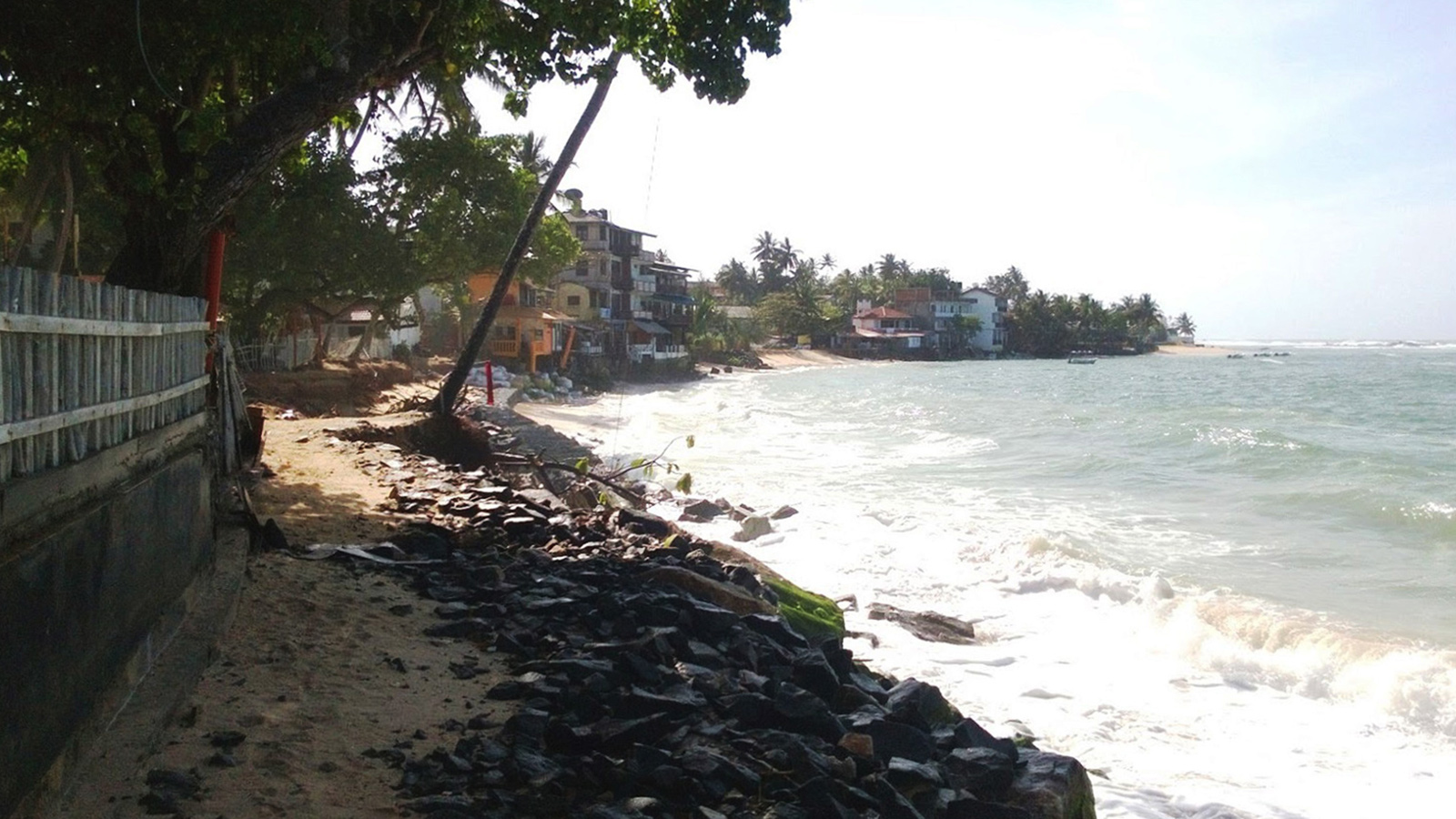
Sri Lanka’s coastline is both a source of livelihood and cultural identity for millions, but it is increasingly under threat from sea erosion. Accelerated by climate change, unsustainable coastal development, and the destruction of natural coastal barriers, erosion is reshaping the lives of coastal communities. The village of Muthupanthiya has been directly impacted by sea erosion, resulting in the loss of homes and displacement of fishing grounds, thus jeopardizing the community’s long-term sustainability. As policy makers and researchers seek sustainable long- term interventions, nature-based solutions are gaining recognition as a strategy that restores ecosystems while addressing social challenges and empowering communities. This article explores the root causes of sea erosion in Sri Lanka, its impact on Muthupanthiya, and how research is turning to nature-based solutions to help preserve traditional culture and protect ecosystems.
The increasing rate of sea erosion in Sri Lanka can be linked to both natural and man-made sources. The most significant natural sources of sea erosion have been global warming and sea level rise. Oceans have absorbed over 90% of the excess heat caused by greenhouse gas emissions since the 1970s1. Warming ocean temperatures have contributed to two major issues: the accelerated melting of glaciers, which drives sea level rise, and significant shifts in atmospheric patterns, which alter rainfall distribution and increase the frequency and severity of storms and irregular weather2. These issues have led to an increase in flooding, droughts, and saltwater intrusion, and have disproportionately impacted poorer countries, contributing to inequality and poverty3. Coastal communities across Sri Lanka have been greatly impacted by climate change. An increase in “climate refugees” is expected as families and entire communities are forced to migrate into neighboring cities due to climate hazards4. Villages are grappling with saltwater intrusion and inundation of their homes putting food production, health, safety, and livelihoods at risk5. With warming and rising oceans, the survival of Sri Lanka’s coastal communities increasingly depends on urgent, coordinated action to mitigate climate impacts and build long-term resilience.
Sand mining
The most significant man-made sources of sea erosion have been sand mining and the surge of coastal infrastructure. Sand acts as a natural coastal buffer against waves and storms, however, unregulated sand mining has greatly reduced the amount of sediment being carried along the coast. Since its introduction to Sri Lanka in the early 1990s, mechanized sand mining has had dire environmental and socio-economic consequences. These include an increase in riverbank erosion, seawater intrusion, salinization of drinking water and irrigation sources, among other issues6. While Sri Lankans have used manual sand mining sustainably for centuries, mechanized sand mining involves the use of heavy machinery, which has subsequently increased the scale and intensity of sand extraction.
This unsustainable approach to sand excavation was further compounded by a surge in demand following the tsunami in 2004. In 2005, demand peaked, doubling the pre-tsunami annual extraction from five to ten million cubic meters to support reconstruction efforts7’8. Despite intervention from the supreme court in 2004 which limited sand mining to specific locations, illegal mining practices continued. It is estimated that more than 35 of the 103 rivers in Sri Lanka are subject to illicit mechanized sand mining, and over 50% of all sand used in the construction sector is extracted through unlawful operations9. Researchers have also determined that excavation rates are currently ten times beyond sustainable extraction limits10. The continuous unregulated removal of river sediment is driving sea erosion across Sri Lanka’s coastline and will continue to negatively impact coastal communities.
Coastal Infrastructure: Hard Structures
Over the past 15 years, coastal erosion has prompted the construction of hard structures across Sri Lanka. These man-made structures are designed to mitigate erosion and flooding by attenuating wave energy and in some cases, trapping sediment. Most districts have implemented revetments, protective slopes designed to absorb wave energy, and groynes which are pier-like structures, to curb coastal erosion11. Although hard structures have become commonplace in Sri Lanka’s efforts to mitigate climate hazards, research now exposes their destructive and unsustainable qualities. Structures that extend out into the sea, such as groynes, serve a dual function: preventing erosion and trapping sediment by obstructing the littoral drift. However, by disrupting the littoral drift and depriving downstream beaches of sediment, these structures amplify coastal erosion further along the shoreline12. Further, structures like revetments that sit on the coastline have had significant ecological drawbacks, such as the adverse effects on sea turtle nesting. Researchers have already witnessed changes in sea turtle behavior, with fewer emerging on beaches that have revetments since these structures are degrading suitable nesting habitats13. Similarly, revetments impede local access to beaches, impacting recreational use and the livelihoods of those who depend on the ocean, such as fisher people14. With Muthupanthiya as one example, these structures are reshaping coastal culture and alienating local communities from nature.
Recent literature has also highlighted the monetary demands of hard structures and the burden they place on developing countries and communities themselves. They are not only expensive to build but require continuous repairs to maintain their usefulness. As the impacts of global warming and sea level rise escalate, their lack of resilience has become increasingly apparent.
Many submerged and low-lying structures, such as groynes, are expected to gradually become ineffective in preventing sea erosion15. Researchers warn against the use of structures that impede the natural longshore drift, as this disruption has well documented social and environmental consequences downstream16. Ultimately, hard structures fail to adequately address coastal erosion given their ecological and economic drawbacks, high construction and maintenance costs, and limited capacity to adapt to increasingly severe climate hazards. This discussion centers exclusively on the effects of hard structures, while recognizing that tourist infrastructure along the coast also contributes significantly to sea erosion in Sri Lanka. However, this analysis is confined to coastal infrastructure within a mitigation-focused framework.
Case Study: Muthupanthiya
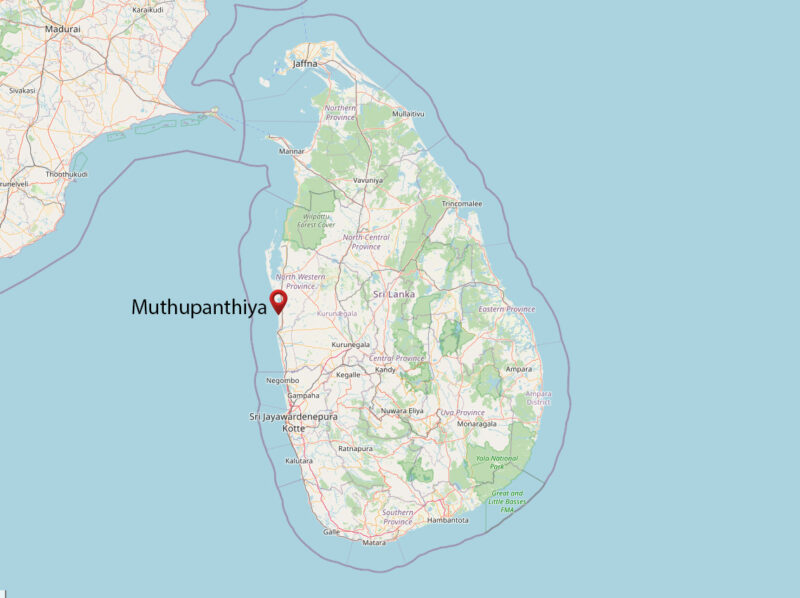
Muthupanthiya is a small coastal island located in the Puttalam District of Sri Lanka’s Northwestern Province. The village is home to more than 150 families, many of which belong to the fishing community17. Muthupanthiya has experienced sea erosion for over a decade, however, its rate and severity have escalated markedly in recent years. Many fisher people have lost their livelihood and over half of their land is now unusable due to damage caused by floodings18. Elder community members have attested to these drastic changes saying they’ve watched the sea move closer to their homes overtime19. The acceleration of sea erosion in Muthupanthiya is due to both natural and man-made sources. The natural causes of sea erosion in Muthupanthiya mirror those affecting Sri Lanka as a whole, primarily driven by global warming and rising sea levels. Since Muthupanthiya sits on the coast, it is greatly impacted by changes in weather patterns and sea levels.
River mining activities occurring in the Maha Oya River approximately 70 kilometers upstream have greatly contributed to sea erosion in Muthupanthiya20. This river naturally transports sand to replenish beaches along the coastline, including Muthupanthiya’s coast. However, as a popular site for sand mining over several decades, the excessive excavation has substantially reduced the sediment supply reaching the coast21. The city of Chilaw, approximately 20 kilometres upstream from Muthupanthiya, also depends on the Maha Oya River for sand replenishment, and has recently been named as one of the most eroded coasts in Sri Lanka22. The loss of sediment along Chilaw’s shoreline prompted the construction of multiple groynes and breakwaters to rebuild the coast23. Both structures have successfully restricted longshore sediment transport and artificially replenished Chilaw’s coastline. However, these protective structures have accelerated coastal erosion on downstream beaches, including Muthupanthiya. A study analyzing breakwater effectiveness concluded that significant and persistent erosion on the downdrift side is an inevitable byproduct of such structures24. The negative impacts of the hard structures built in Chilaw have recently been acknowledged by the Coast Conservation and Coastal Resource Management Department in Sri Lanka in 2024. Their report confirmed that by obstructing the natural littoral drift, hard structures deprive downstream areas of sand, escalating coastal erosion25. Further research needs to be conducted to evaluate the environmental and economic impact mitigation strategies have on neighboring communities before being implemented.
The first strategy to mitigate sea erosion in Muthupanthiya was a hard structure: a jetty made of boulders implemented by the Coast Conservation Department in 201726. Jetties extend out into the sea with the goal of redirecting the longshore current, trapping more sediment, and stabilizing the shoreline. However, when locals advised against the proposed construction model and offered a more suitable alternative, they were ignored27. Since its construction, the structure has caused more damage than it has alleviated. According to locals, the boulders will soon succumb to the erosion they were meant to prevent and be “swallowed by the sea”28. The Jetty has had economic consequences as well, most notably for fisher peoples29. Muthupanthiya Fishing Association leader Roshan Fernando stated that since the jetty’s construction, sea erosion has rapidly increased and become a big struggle for the fisher folk. Unable to properly anchor their boats, draw their boats ashore, and having lost fishing nets to strong currents, the community now only practices fishing occasionally30’31. The cost of implementing hard structures has also posed an economic challenge for the country. The jetty constructed in Muthupanthiya required a 30 million RS investment from the government, however, after succumbing to erosion after only a year, another 20 million RS investment is already being discussed, only two years after its construction32. Further intervention that prioritizes sustainability and communal insight is necessary and urgent, with the survival of Muthupanthiya depending on it.
Recommendations
To combat the climate crisis in Sri Lnka and protect local communities and habitats, nature- based strategies should be considered. This approach focuses on sustainably managing and restoring ecosystems, addressing social and economic challenges, and empowering local communities33. Nature-based solutions can be framed within a cultural and ecological context, tailoring mitigation strategies to the needs of individual communities. They accomplish this by making community members leaders in decision making. Local people are closest to the ecology of their environment, making them well positioned to understand the key driving factors of ecological degradation34. The impacts of climate change disproportionately affect marginalized groups, including small coastal communities who rely on their natural environment for sustenance and livelihoods, making them highly vulnerable to climate-based disruptions. Nature-based solutions ensure that the ecological, economic, and cultural dimensions of specific regions are equally considered when devising solutions.
Considering Muthupanthiya’s coastal ecology, mangrove restoration and plantation would likely be the most compatible and effective nature-based solution since there are multiple species of mangroves native to this area. Within the Muthupanthiya region there are 13 true mangrove species, including Rizhophora mucronate which has shown to have an 80-85% survival rate35. Mangroves have endless benefits; economic, social and environmental, and are a naturally occurring ecosystem in Sri Lanka. Economically, mangroves provide locals with resources such as organic fertilizers, medicinal plants, and building materials which also opens doors to various streams of income36. Socially, they provide monetary opportunities that are accessible to marginalized groups, fostering greater equality. Community-led strategies have shown to promote social inclusion and bridge the gap between marginalized groups and equitable development37.
Environmentally, mangroves increase marine biodiversity and protect the coast against storms, sea level rise, sea erosion, and mediate against tsunamis38. Research simulations have been conducted to test the resilience of mangroves to sea level rise specifically, with results reinforcing that mangroves are an effective natural solution to protect coastlines39. Mangroves not only protect against climate change but improve the climate; acting as carbon sinks which prevent carbon from entering the atmosphere40. The small Indonesian village of Demak has successfully utilized mangrove restoration to combat sea level rise, erosion, and to rehabilitate their coastal community. Like Muthupanthiya, Demak is a fishing village that witnessed large areas of land disappear due to inundation and erosion. In addition to the climate benefits they’ve experienced, the project revitalized fishing livelihoods and generated jobs through the maintenance of the mangroves41. By focusing climate funding and research on nature-based solutions including mangroves, Sri Lanka can invest in solutions that grow with the natural environment, improving biodiversity, quality of life, and effectively combating the climate crisis. Ultimately, mangroves encompass a culturally informed nature-based strategy against sea level rise and sea erosion in Sri Lanka’s coastal communities.
Conclusion
As Sri Lanka grapples with the growing threat of sea erosion, the need for innovative and multifaced solutions becomes more pressing. The consequences of climate change and unsustainable development have cost communities their homes, livelihoods, and culture. Coupled with the detrimental impact they’ve had on marine ecosystems; immediate intervention is needed to prevent the erosion of Sri Lanka’s coastal and marine culture. The case of Muthupanthiya illustrates how unregulated urbanization and climate change intersect, creating environmental degradation and social vulnerability. To support and protect communities like Muthupanthiya, solutions need to be ecologically sound and socially inclusive. Nature-based solutions offer a promising framework that combines environmental restoration with social rehabilitation. Mangrove plantation would allow coastal communities to address these challenges simultaneously, without the use of invasive or artificial mechanisms that encroach on Sri Lanka’s rich culture and alter the native seascape. Effective adaptation to coastal erosion requires solutions grounded in ecological integrity and social equity – a framework essential for building resilient coastal communities and conserving Sri Lanka’s marine habitats amid.
References
1. International Union for Conservation (IUCN). (2017). “Ocean Warming“. Issues Brief, November 2017. Available from: https://iucn.org/resources/issues-brief/ocean-warming
2. Samaraweera, G.R.L., Dharmadasa, R.A.P.I.S., Kumara, P.H.T. & Bandara, A.S.G.S. (2024). “Evidence of Climate Change Impacts in Sri Lanka – A Review of Literature”. Sri Lanka Journal of Economic Research. Available from: https://doi.org/10.4038/sljer.v11i2.205
3. United Nations. (2021). “Climate and Weather-Related Disasters Surge Five-old Over 50 years, but Early Warnings Save Lives”. WMO report. United Nations News. Available from: https://news.un.org/en/story/2021/09/1098662
4. Samaraweera, G.R.L., Dharmadasa, R.A.P.I.S., Kumara, P.H.T. & Bandara, A.S.G.S. (2024). op. cit.
5. Samaraweera, G.R.L., Dharmadasa, R.A.P.I.S., Kumara, P.H.T. & Bandara, A.S.G.S. (2024). op. cit.
6. Global Water Partnership. (2018). “Curbing Unregulated River Sand Mining in Sri Lanka”. Available from : https://www.gwp.org/en/we-act/change-and-impact/Impact- Stories/curbing-unregulated-river-sand-mining-in-sri- lanka/#:~:text=A%20growing%20construction%20boom%20has%20seen%20the,along%20t he%20Maha%20Oya%20river%2C%20by%20SLWP
7. Environmental Foundation Limited. (2025). “Mechanized Sand Mining in Maha Oya, Sri Lanka”. Available from : https://ejatlas.org/print/mechanized-sand-mining-in-the-maha-oya-sri-lanka
8. Weerasekera, D. (2014). “Digging For Development: the Hidden Cost of Sand”. International Water Management Institute. Available from : https://www.iwmi.org/news/digging-for-development/
9. Global Water Partnership. (2018). “Curbing Unregulated River Sand Mining in Sri Lanka”. op. cit.
10. Ibid.
11. Abeykoon, L.C.K., Thilakarathne, E.P.D.N., Abeygunawardana, A.P., Warnasuriya, T.W.S., & Egodauyana, K.P.U.T. (2021). “Are Coastal Protective Hard Structures Still Applicable with Respect to Shoreline Changes in Sri Lanka?”. Tokyo: Asian Development Bank Institute. Available from : https://www.adb.org/sites/default/files/publication/692461/adbi-wp1240.pdf
12. North Carolina Coastal Federation. (2025). “Terminal Groins”. Available from : https://www.nccoast.org/coastal-management/terminal-groins/
13. Sanitwong-Na-Ayutthaya, S., Saengsupavanich, C., Ariffin, E. H., Ratnayake, A. S., & Yun, L. S. (2023). “Environmental Impacts of Shore Revetment”. Heliyon. Available from : 10.1016/j.heliyon.2023.e19646
14. Sanitwong-Na-Ayutthaya, S., Saengsupavanich, C., Ariffin, E. H., Ratnayake, A. S., & Yun, L. S. (2023). op. cit.
15. Rashidi, A. H. M., Jamal, M. H., Hassan, M. Z., Sendek, S. S. M., Sopie, S. L. M., & Hamid, M. R. A. (2021). “Coastal Structures as Beach Erosion Control and Sea Level Rise Adaptation in Malaysia: A Review“. Water, 13(13), 1741. Available from : https://doi.org/10.3390/w13131741
16. Rashidi, A. H. M., Jamal, M. H., Hassan, M. Z., Sendek, S. S. M., Sopie, S. L. M., & Hamid, M. R. A. (2021). op. cit.
17. Bandara, S. (2019). “Battling Coastal Erosion”. The Morning. Available from : https://www.themorning.lk/articles/47660
18. Ibid.
19. The Sunday Times. (December 2017). “Muthupanthiya Fisher Folk Fear Their Island Village May Disappear”. Available from : https://www.sundaytimes.lk/171231/news/muthupanthiya-fisher-folk-fear-their-island-village-may-disappear-275490.html
20. Biodiversity Sri Lanka. (2016). “Maha Oya Sand Mining To Affect”. Available from : https://biodiversitysrilanka.org/tag/soil-erosion/
21. Ibid.
22. Abeykoon, L.C.K., Thilakarathne, E.P.D.N., Abeygunawardana, A.P., Warnasuriya, T.W.S., & Egodauyana, K.P.U.T. (2021). op. cit.
23. Abeykoon, L.C.K., Thilakarathne, E.P.D.N., Abeygunawardana, A.P., Warnasuriya, T.W.S., & Egodauyana, K.P.U.T. (2021). op. cit.
24. Saengsupavanich, C., Ariffin, E. H., Yun, L. S., Pereira. D. A. (2022). “Environmental Impact of Submerged and Emerged Breakwaters”. Heliyon, Volume 8, Issue 12. Available from : https://doi.org/10.1016/j.heliyon.2022.e12626
25. Ministry of Urban Development and Housing. (2024). “Sri Lanka Revised Coastal Zone and Coastal Resource Management Plan”. Ministry of Urban Development and Housing. Available from : https://coastal.gov.lk/images/pdf/CZMP_24- 29/SRI_LANKA_REVISED_COASTAL_ZONE_AND_COASTAL_RESOURCE_MANAG EMENT_PLAN_2024.pdf
26. The Sunday Times. (December 2017). “Muthupanthiya Fisher Folk Fear Their Island Village May Disappear”. op. cit.
27. The Sunday Times. (December 2017). “Muthupanthiya Fisher Folk Fear Their Island Village May Disappear”. op. cit.
28. The Sunday Times. (December 2017). “Muthupanthiya Fisher Folk Fear Their Island Village May Disappear”. op. cit.
29. The Sunday Times. (December 2017). “Muthupanthiya Fisher Folk Fear Their Island Village May Disappear”. op. cit.
30. The Sunday Times. (December 2017). “Muthupanthiya Fisher Folk Fear Their Island Village May Disappear”. op. cit.
31. Hiru News (March 2021). 10 Families Displaced After Protective Barrier of Muthupanthiya Breaks. Available from : https://www.hirunews.lk/english/264065/10-families- displaced-after-protective-barrier-of-muthupanthiya-breaks
32. The Sunday Times. (December 2017). “Muthupanthiya Fisher Folk Fear Their Island Village May Disappear”. op. cit.
33. Gajjar, S. P. (2020). “Nature-based Solutions to Climate Change in Coastal Cities”. South African Institute of International Affairs. Available from : https://www.researchgate.net/publication/343892466_Nature-based_solutions_to_climate_change_in_coastal_cities
34. Ibid.
35. Wildlife and Nature Protection Society. (2024). “Anawilundawa ANRM Project: Where People, Nature Thrive Hand in Hand With Mangroves ». Available from : https://www.wnpssl.org/news/ANRM.html
36. Ewel, Katherine & Twilley, Robert & Ong, Jin. (1998). “Different Kinds of Mangrove Forests Provide Different Goods and Services”. Global Ecology and Biogeography Letters. 7. 83-94. https://www.researchgate.net/publication/261806463_Different_Kinds_of_Mangrove_Forests_Provide_Different_Goods_and_Services
37. Honig, M., & Clarke, P. (2024). “Coastal Communities Lead Successful Marine Conservation Efforts”. WWF. Available from : https://coastalcommunityledconservation.org/wp-content/uploads/2024/03/WWF-Coastal-Communities-Initiative-Impact-Report-2020-2023.pdf
38. Bizenjo, S. & Shahzar, E. (2022). “4 Ways to Shore up South Asian Coastal Communities Against Climate Change”. World Economic Forum. Available from : https://www.weforum.org/stories/2022/10/south-asia-flooding-climate-change/
39. Science Daily (july 2015). “Mangroves help protect against sea level rise”. Available from : https://www.sciencedaily.com/releases/2015/07/150723083855.htm
40. Bizenjo, S. & Shahzar, E. (2022). op. cit.
41. United Nations Development Program. (2024). “People and Planet: Addressing the Interlinked Challenges of Climate Change, Poverty and Hunger in Asia and the Pacific”. Available from : https://www.undp.org/asia-pacific/publications/people-and-planet-addressing-interlinked-challenges-climate-change-poverty-and-hunger-asia-and-pacific