
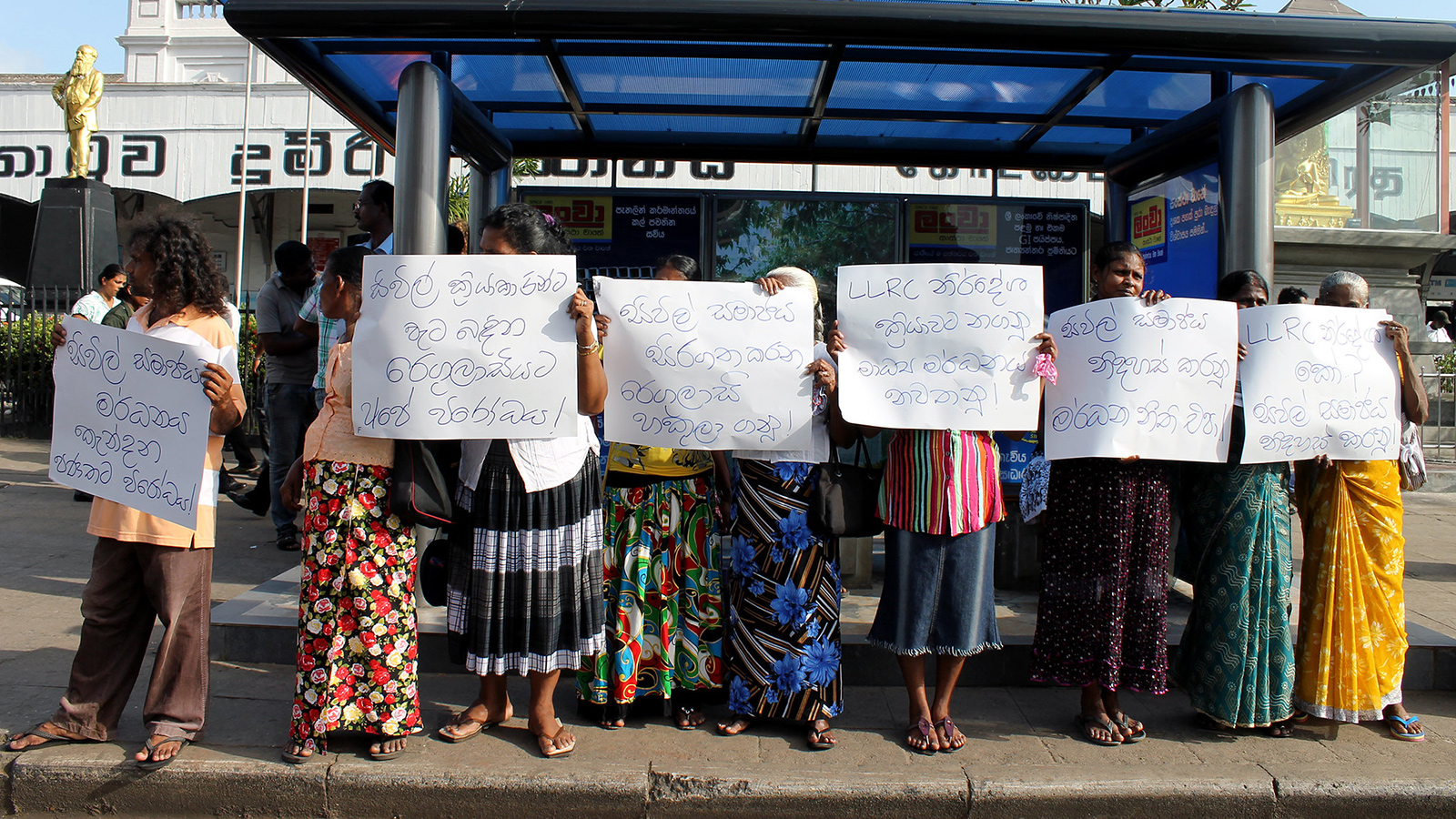
According to the CIVICUS Monitor, a monitoring system which evaluates the state of civil society freedoms in all countries, Sri Lanka has been considered a “repressed” state since December 2023. This ranking places it one rung above “closed”. Now, four months into the new leadership of President Dissanayake, continued harassment, intimidation, and unlawful behaviour towards human rights defenders (HRDs) persists.
Context: Sri Lanka’s Recent History
In order to understand the country’s current situation, a summary of Sri Lanka’s recent history is necessary. From July 1983 to May 2009, Sri Lanka experienced a devastating 30-year civil war, rooted in ethnic conflict between the Sinhalese (who composed 70-75% of the population) and the Tamils (10-20%). The violent struggle was believed to have surfaced around the time of the country’s independence from British rule in 1948, but its origins have been traced back to the colonial era1. Due to this long and complicated history, sentiments of being wronged are felt by all; however, it is believed that a trigger for the Tamil separatist movement (mobilized through the Liberation Tamil Tigers of Eelam) was that the Sinhalese-dominated government used institutionalized political violence to discriminate against Tamils2. Some of this discrimination included passing the “Sinhala Only Act,” failing to implement proposals to foster a federal type of regional autonomy for Tamil-dominant areas, and amending the law to enact the draconian Prevention of Terrorism Act (PTA) to control a rising opposition in the country3. Many Tamils lost confidence in the Government and in peaceful protests. Violent conflict escalated and war crimes committed by the Sri Lankan army and the LTTE were rampant. The war concluded by force as the Sri Lankan army overtook the LTTE, but limited efforts towards ethnic reconciliation have been effectively implemented since the intense militarization of civil society: though meant to be temporary, the PTA remains a tool to suppress HRDs; the military continues to occupy the Northern and Eastern provinces; there has been insufficient accountability for the human rights abuses suffered at the hands of the Government; and Tamils continue to face marginalization in socio-econo-politico realms4. As such, the memories of the past, along with ongoing injustices, continue to shape group sentiments and division5.
Recent Increase in Unlawful Measures to Oppress Dissent
Sri Lanka was downgraded from ‘oppressed’ to ‘repressed’ in December 2023 by the CIVICUS Monitor6. Under President Wickremesinghe (2022-2024), rising frustration among the public about poor governance and a lack of accountability were met with authorities targeting HRDs through detensions, threats, and unlawful methods to disperse protestors7. Continued human rights abuses persist, with the UN Office of the High Commissioner for Human Rights (OHCHR) reporting that members of civil society continue to be monitored, unlawfully arrested, and reported missing.
Harassment of HRDs Under President Dissanayake’s Government
On September 21, 2024, President Dissanayake (of the National People’s Power party, NPP) was elected and became the first president to be elected while not belonging to one of Sri Lanka’s two traditional political parties8. It is believed he won the election by appealing to various voter groups by embodying popular anti-establishment anger rather than resorting to divisive Sinhala nationalist discourse as had been done in the past9. During the election, the NPP made promises to end corruption, foster economic relief, and improve the civic space by repealing the PTA10’11. Much of the public considers this new Government under the leftist party’s leadership to be ‘people-friendly.’ However, mounting pressure has arisen as the Government strives to fulfill its pledges while managing domestic and international challenges12.
As HRDs continue to strive to hold the Government accountable, the civic space remains restricted. Since assuming office, the NPP announced that it will not repeal the PTA as the issue is with its misuse; however, it remains unclear how the Government plans to mitigate its misuse13. Over the last few years, there has been a concerning lack of confidence in good governance among the public, coupled with a growing sense of disillusionment with the ability for the Human Rights Commission of Sri Lanka (HRCSL) to investigate complaints. In February 2025 at a NAFSO-facilitated national civil society dialogue, members reported that in their dialogues with HRCSL investigators, officers claimed that it would take two to three years to investigate the complaints lodged to date due to low staffing and the high volume of complaints. The cases filed allegedly exceed 9,000. It is believed that disillusionment in these systems has led to lower voter turnout14, decreased motivation to report injustices going forward, and uncertainty about how to pursue accountability.
The OHCHR reports that they have “observed a persistent trend of surveillance, intimidation and harassment of journalists and civil society actors, especially those working on enforced disappearances, land seizures, environmental issues, and with former combatants in Sri Lanka’s north and east”15. These cases have continued under President Dissanayake’s leadership. In October 2024, the President of the Mannar District Families of the Disappeared organization faced an attempt by Sri Lankan police to arrest her at her home while she was away. Informed that she must report to the police station on her return, she was told she must either pay a fine of Rs. 100,000 or “face further consequences”16.
The OHCHR also reported that a clear pattern of “Tamils, primarily men who had been involved in protests over disappearances, land/environmental rights or commemoration of war victims and were believed to be previously involved or linked with the [LTTE], were monitored or photographed, and subsequently arrested by people who verbally identified themselves as police CID [Criminal Investigations Department] or TID [Terrorist Investigation Division] personnel” or they were reported to have gone missing17. On December 26, 2024, a Tamil journalist known for reporting on political corruption, social issues, illegal drug trades, and environmental destruction was assaulted and victim of an attempted abduction. Though he identified two suspects whom the police arrested in court, they were released on bail a few days after18. Similarly, in the final months of 2024, a Tamil journalist was arrested by police officers for his reporting on alleged corruption in 202019 and a Tamil human rights defender was unlawfully interrogated by the police and the CID’s Counter-Terrorism Investigations Division (CTID) for a protest she staged in 202220.
Further, despite the Government’s claims that there are no restrictions on family members to memorialise their loved ones as long as it did not glorify terrorism, several commemoration events were disrupted, particularly in the Eastern Province21. For instance, numerous Tamil volunteers in Batticaloa and Jaffna preparing for Maaveerar Naal, an annual commemoration for fallen Tamil fighters, were summoned by police over their preparation activities, in a reported attempt to disrupt preparations22’23. At the events, Tamil families of the disappeared were subjected to intimidation and surveillance by a plain-clothes Sri Lankan intelligence officer24. Further, they interrogated Tamils for holding a birthday celebration outside the LTTE leader’s now destroyed house in November and numerous individuals were questioned for their connection to Facebook posts referencing the former LTTE leader (Tamil Guardian, 2024b; Tamil Guardian, 2024g).
Nonetheless, the harassment of HRDs by law enforcement and restriction of their activities are not limited to matters regarding the ethnic conflict. The HRCSL reported that two of the HRDs who staged a peaceful protest against the deportation of Rohingya asylum seekers to Myanmar in Mullaitivu, a predominantly Tamil area, were summoned by CID’s Human Trafficking, Smuggling, and Maritime Crimes Investigation Division due to their involvement in the protest27. This protest was staged at a time when the latest announcement from the Government was that they were exploring the possibility of deporting the Rohingya asylum seekers, though the Government announced on February 2nd that they would not deport them28. Harassment of these HRDs by the CID occurred nonetheless.
As posted on NAFSO’s Facebook, on February 21st, Negombo People’s Council launched a signature campaign in front of Negombo’s bus stand. They launched this campaign to demand the government honour its promise to repeal the “temporary” act enacted in 1979. Specifically, they demanded the repeal of the PTA and that until it is repealed, government authorities cease to harass or arrest HRDs, political activists, and media journalists using its provisions.
Meenakshi Ganguly, deputy Asia director at Human Rights Watch, stated that “Sri Lanka’s multiple crises are connected by entrenched impunity for rights violations, discrimination against minority communities, and laws and institutions that seek to silence critics…President Dissanayake has an opportunity to make real progress on rights if he carries out his campaign pledges, but he also needs to address the legacy of past conflicts and continuing abuses against Tamils, Muslims, and others on which he has been troublingly silent”29. Despite the UN’s finding that there are reasonable grounds to believe grave violations of human rights were committed during the war, the OHCHR declares that the Government has failed to credible advance accountability and reconciliation30. Although the Government has changed, its mechanisms have not. As the international community backs HRD’s calls for change, the public eagerly waits to see whether President Dissanayake will honour his commitments and make structural change, or continue to allow or encourage these systems to oppress citizens and those who represent them in civil society.
Calls to Action
Civil society should therefore continue to call the Government to action through the following proposals suggested by the International Federation for Human Rights (2025):
- Reopen or initiate impartial transparent investigations in cases of violations of human rights and freedom of expression – including those which took place during the war and its aftermath.
- Adequately staff these investigations to enable more thorough and swift responses to complaints lodged through these units and the Human Rights Commission.
- Ensure that law enforcement agencies end the harassment and intimidation of journalists.
- Repeal the Online Safety Act (passed in 2024) which is subjective and not consistent with the constitution, thereby enabling misuse by authorities.
- Repeal the Prevention of Terrorism Act as it has been used to harass, imprison, and enforce disappearances of journalists.
- Amend the Parliamentary Act which limits transparency by preventing reporting on parliamentary affairs.
- Amend the Personal Data Protection Act to remove provisions allowing the law to override the Right to Information Act.
- Establish an independent, self-regulatory media commission that will uphold press freedom and manage matters of journalistic ethics.
About NAFSO
Founded in 1997, NAFSO works with and for small-scale fisherfolk communities, focusing on artisanal fisherfolk, women and youth empowerment, reconciliation, environmental protection, food sovereignty, and land rights. Its work includes community organizing, advocacy, training, and resource provision. As a bilingual organization with both Sinhala and Tamil members, NAFSO prioritizes inclusive participation in all activities, ensuring language is never a barrier.
References
1. Perera, S. (2001). “The political economy of policy reform: Issues and implications for policy dialogue and development operations”. World Bank. https://documents1.worldbank.org/curated/en/727811468302711738/pdf/677060WP00PUBL0io0political0Outline.pdf
2. Ibid.
3. Ibid.
4. United Nations Human Rights Council. (2024). “Situation of human rights in Sri Lanka: Comprehensive report of the United Nations High Commissioner for Human Rights (A/HRC/57/19)”. https://www.ohchr.org/en/documents/reports/ahrc5719-situation-human-rights-sri-lanka-comprehensive-report-united-nations
5. Harrison, F., & Keenan, A. (Eds.). (2017). Sri Lanka at the crossroads of history. UCL Press. https://discovery.ucl.ac.uk/id/eprint/1557938/1/Sri-Lanka-at-the-Crossroads-of-History.pdf?ref=hir.harvard.edu
6. CIVICUS. (January 29, 2024). “Sri Lanka: Authorities continue to stifle protests, harass activists and push repressive laws”. CIVICUS Monitor. https://monitor.civicus.org/explore/sri-lanka-authorities-continue-to-stifle-protests-harass-activists-and-push-repressive-laws/
7. Ibid.
8. Gunawardena, D., & Kadirgamar, A. (September 28, 2024). “A political and policy tightrope awaits Sri Lanka’s new president. East Asia Forum”. https://eastasiaforum.org/2024/09/28/a-political-and-policy-tightrope-awaits-sri-lankas-new-president/
9. Gamage, R., & Dassanayake, H. (September 25, 2024). “A new era in Sri Lanka?: Implications of Dissanayake’s presidency”. South Asian Voices. https://southasianvoices.org/pol-c-sl-n-dissanayake-win-09-25-2024/
10. Ibid.
11. CIVICUS. (January 13, 2025). “Sri Lanka: Civic space restrictions and targeting of activists persist as new government takes power”. CIVICUS Monitor. https://monitor.civicus.org/explore/sri-lanka-civic-space-restrictions-and-targeting-of-activists-persist-as-new-government-takes-power/
12. Gunawardena, D., & Kadirgamar, A., op. cit.
13. Samaraweera, B. (October 29, 2024). “Govt. says will not repeal PTA but prevent misuse. The Morning”. https://www.themorning.lk/articles/MgX76oxs7Op3MMT3cytl
14. Gamage, R., & Dassanayake, H., op. cit.
15. United Nations Human Rights Council. (2024), op. cit.
16. Tamil Guardian. (Octobre 21, 2024). “Sri Lankan police target yet another Tamil mother of the disappeared”. Tamil Guardian. https://www.tamilguardian.com/content/sri-lankan-police-target-yet-another-tamil-mother-disappeared
17. United Nations Human Rights Council. (2024). op. cit.
18. Tamil Guardian. (January 12, 2025). “Committee to Protect Journalists calls for « swift and impartial » investigation into attempted abduction of Tamil journalist”. Tamil Guardian. https://www.tamilguardian.com/content/committee-protect-journalists-calls-swift-and-impartial-investigation-attempted-abduction
19. Tamil Guardian. (October 21, 2024). “Sri Lankan police arrest Tamil journalist after exposing government corruption”. Tamil Guardian. https://www.tamilguardian.com/content/i-was-treated-murderer-sri-lankan-police-arrest-tamil-journalist-after-exposing-government
20. Ceylon News. (December 19, 2024). “Tamil mother who led protest demanding medication interrogated by police”. Ceylon News. https://english.ceylonnews.lk/tamil-mother-who-led-protest-demanding-medication-interrogated-by-police/
21. United Nations Human Rights Council. (2024). op. cit.
22. Tamil Guardian. (November 22, 2024). “No flags, no flowers: Sri Lankan police summon volunteers ahead of Maaveerar Naal“. Tamil Guardian. https://www.tamilguardian.com/index.php/content/no-flags-no-flowers-sri-lankan-police-summon-volunteers-ahead-maaveerar-naal
23. Tamil Guardian. (December 8, 2024). “Sri Lankan police interrogate two Tamil men over Maaveerar Remembrance Week commemorations”. Tamil Guardian. https://www.tamilguardian.com/index.php/content/sri-lankan-police-interrogate-two-tamil-men-over-maaveerar-remembrance-week-commemorations
24. Tamil Guardian. (December 10, 2024). “Sri Lankan intelligence officer intimidates Tamil families of the disappeared in Mullaitivu”. Tamil Guardian. https://www.tamilguardian.com/index.php/content/sri-lankan-intelligence-officer-intimidates-tamil-families-disappeared-mullaitivu
25. Tamil Guardian. (November 30, 2024). “Sri Lanka arrests Tamil man under PTA for Facebook post”. Tamil Guardian. https://www.tamilguardian.com/content/sri-lanka-arrests-tamil-man-under-pta-facebook-post
26. Tamil Guardian. (December 24, 2024). “TID investigates man for two-year-old social media post on Prabhakaran’s birthday”. Tamil Guardian. https://www.tamilguardian.com/content/tid-investigates-man-two-year-old-social-media-post-prabhakarans-birthday
27. Human Rights Commission of Sri Lanka. (January 31, 2025). “Report on the status of Rohingya asylum seekers detained in Mullaitivu, and related issues”. https://www.hrcsl.lk/wp-content/uploads/2025/01/HRCSL-Report-on-Rohingya-Asylum-Seekers_January-2025.pdf
28. Weerasinghe, T. (February 2, 2025). “Rohingya refugees: The stay lengthens amidst concerns about the care provided”. The Sunday Times. https://www.sundaytimes.lk/250202/new
29. Human Rights Commission of Sri Lanka. (January 31, 2025). “Report on the status of Rohingya asylum seekers detained in Mullaitivu, and related issues”. https://www.hrcsl.lk/wp-content/uploads/2025/01/HRCSL-Report-on-Rohingya-Asylum-Seekers_January-2025.pdf
30. United Nations Human Rights Council. (2024), op. cit.