
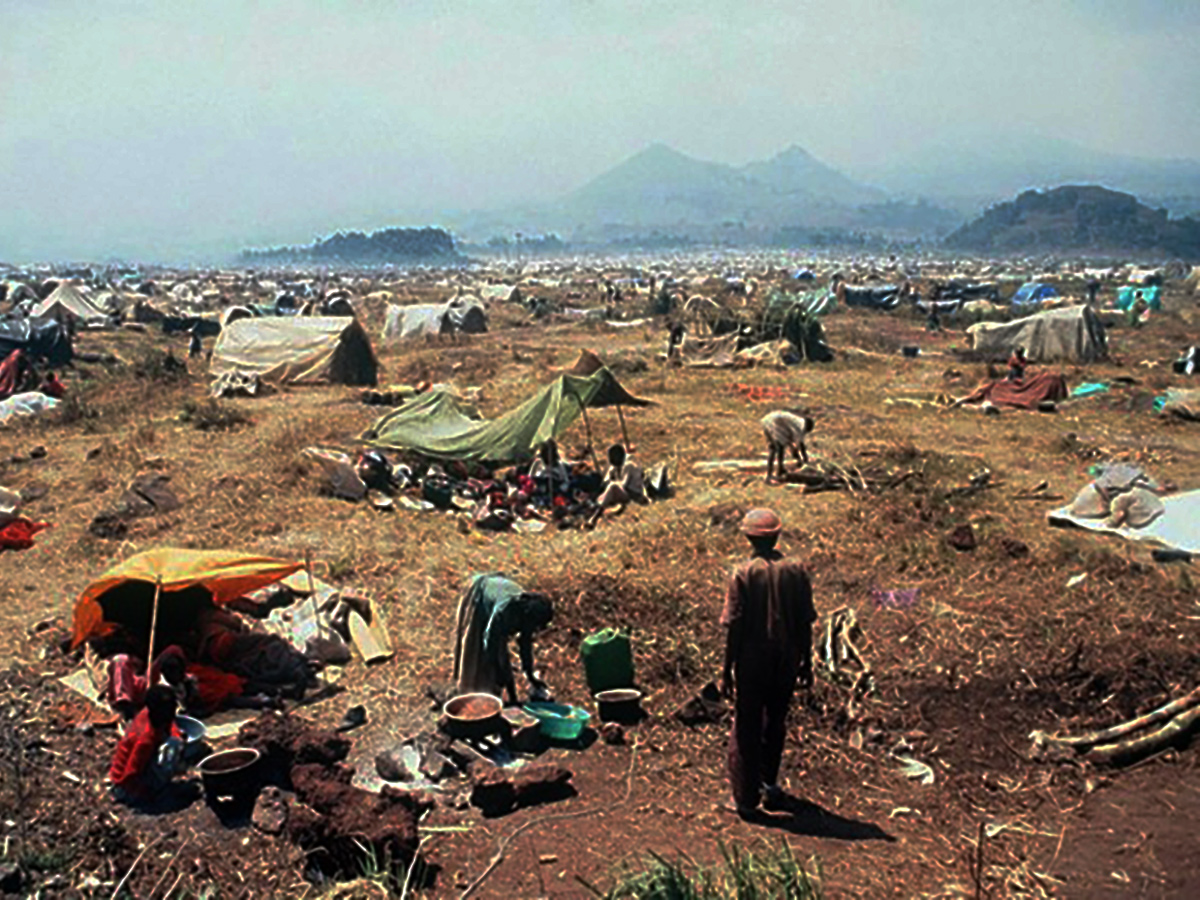
The Rwandan genocide in the 1990s is closely linked to the crimes against humanity perpetrated in the Democratic Republic of Congo thereafter. Against the backdrop of a catastrophic colonial legacy and the international community’s inability to act, the historical context of violence in the Great Lakes region must enable us to learn from past mistakes in order to break this macabre cycle.
The Rwandan Genocide and Its Aftermath
To understand the ongoing genocide in the eastern Democratic Republic of the Congo (DRC), it is crucial to grasp the history of the Rwandan Genocide of the 1990s. Between April and July 1994, approximately one million Tutsis and moderate Hutus were brutally murdered in a genocide that lasted 100 days, while the international community, including UN peacekeepers, stood largely inactive1. This catastrophic event triggered a mass exodus, with the UNHCR estimating that by late August 1994, two million refugees fled into neighboring countries, including 1.2 million into Goma, in North Kivu, Zaire (now the DRC)2. Nearly half of Rwanda’s population of seven million was either killed or displaced.
Colonial Legacy and Ethnic Divisions
The Rwandan Genocide was not an isolated incident, but rather the culmination of centuries of colonial exploitation. German and Belgian colonial powers introduced racial distinctions among the Rwandan ethnic groups, fostering divisions based on physical characteristics. These distinctions, derived from European racial categorizations, fundamentally altered the social fabric of Rwanda, where Hutus, Tutsis, and Twa had previously shared common language and culture. This racialization of ethnicity under colonial rule laid the groundwork for later genocidal violence3.
The Civil War and the Rise of Hutu Power
When Rwanda gained independence in 1962, power shifted to the Hutus, who were the ethnic majority. Initially, Tutsis had ruled Rwanda until the Hutu peasant revolts of 1959 forced the Belgians to support the Hutu majority4. The Hutu-led government, upon assuming power, launched an intense campaign of discrimination, leading to a civil war and, eventually, genocide.
The Civil War between the government forces and the Tutsi-led Rwandan Patriotic Front (RPF) escalated tensions and fostered anti-Tutsi propaganda. In 1990, the Hutu Power ideology, which saw Tutsis as foreign invaders rather than a legitimate ethnic group, gained ground. In 1990, the infamous “Hutu Ten Commandments” were published, calling for the exclusion of Tutsis from various aspects of life, including business, politics, and education5. The publication cemented the notion that there should be no mercy for Tutsis.
The Genocide and Its Regional Consequences
When President Juvénal Habyarimana’s plane was shot down in April 1994, it marked the official beginning of the genocide. Fueled by ethnic hatred and political unrest, the ensuing violence led to the mass murder of over 800,000 Tutsis and moderate Hutus6. This horrific event also triggered a regional conflict, as refugees fled into neighboring countries, further destabilizing the Great Lakes region. The genocide’s aftermath ignited a series of interwoven conflicts, including the First and Second Congo Wars, which displaced millions and exacerbated a major humanitarian crisis7’8. Despite widespread international awareness, the global community failed to intervene, leaving a legacy of unresolved grievances and ongoing suffering.
Refugee Crisis and the First Congo War
The mass exodus of refugees to Zaire, numbering in the millions, had serious consequences. The influx of displaced Rwandans resulted in the establishment of several large refugee camps in the eastern part of Zaire, particularly in Goma. These camps quickly became a hotspot for the defeated Rwandan Armed Forces (FAR) and the Hutu militia group, the Interahamwe—both groups responsible for the genocide9. The presence of these armed groups turned the camps into dangerous places, where refugees became pawns in a political struggle. Despite efforts by the UNHCR to provide protection, the situation was untenable. Refugees suffered from insecurity and violence at the hands of these groups, while the difficult terrain and lack of infrastructure made aid distribution challenging10.
A cholera outbreak in the camps exacerbated the crisis, with an estimated 12,000 deaths, peaking at 3,000 deaths per day before the epidemic was brought under control11. The weak governance in Zaire at the time compounded the crisis, as the country struggled to manage both the refugees and its own internal instability12.
The Rise of Laurent-Désiré Kabila and the DRC’s Transformation
The First Congo War, often referred to as “Africa’s First World War,” erupted in 1996, further complicating the situation. Zaire’s dictator, Mobutu Sese Seko, had led the country since 1971, but by the mid-1990s, his regime was in political and economic collapse. The destabilizing effects of the 1994 genocide, which led to an influx of refugees and armed groups, worsened an already precarious situation13. Mobutu’s corrupt and ineffective government, weakened by years of dictatorship, was ill-equipped to handle the growing crisis.
In October 1996, Rwanda invaded eastern Zaire to target refugee rebel groups. They were joined by Uganda, Burundi, Angola, and Eritrea14. Despite efforts by the Zairian government to resist, the regime quickly collapsed, resulting in widespread violence and ethnic killings. The war would eventually lead to the rise of Laurent-Désiré Kabila, who took power and renamed the country the Democratic Republic of the Congo15. The conflict, however, continued to spread, resulting in further deaths and displacements.
Conclusion: The Continuing Legacy of Violence in the Great Lakes Region
The interconnected genocides in the Great Lakes region, particularly the Rwandan Genocide and the subsequent conflicts in the Democratic Republic of Congo, have left deep scars on the region. Despite the international community’s failure to intervene effectively during the 1990s, the legacy of violence, displacement, and instability continues to affect millions. The lack of accountability for past atrocities, combined with ongoing political and ethnic tensions, ensures that the people of the region still grapple with the consequences of these conflicts. Understanding the historical context of these genocides is crucial not only to comprehend the current crisis but also to work toward long-term peace and justice for the survivors. The international community must learn from past mistakes and take meaningful action to address the root causes of violence and ensure that such tragedies are never repeated.
References
1. University of Minnesota. (april 2025). “Rwanda. Holocaust and Genocide Studies Resource Guides”. Available from : https://cla.umn.edu/chgs/holocaust-genocide-education/resource-guides/rwanda
2. United Nations High Commissioner for Refugees (UNHCR). (2000).” The Rwandan Genocide”. Available from : https://www.unhcr.org/sites/default/files/legacy-pdf/3ebf9bb60.pdf
3. University of Minnesota. (april 2025). op. cit.
4. Ibid.
5. Seminega, Tharcisse. (2019). “No Greater Love (Appendix 3).” Davenport, IA: GM&A Publishing. Available from : https://www.rwanda-nogreaterlove.com/hutu-10-commandments
6. United Nations High Commissioner for Refugees (UNHCR). (2000). op. cit.
7. Enough Project. (2011). “Congo: The First and Second Wars, 1996-2003”. Available from : https://enoughproject.org/blog/congo-first-and-second-wars-1996-2003
8. Council on Foreign Relations. (March 2025). “Conflict in the Democratic Republic of Congo”. Global Conflict Tracker. Available from : https://www.cfr.org/global-conflict-tracker/conflict/violence-democratic-republic-congo
9. Médecins sans frontières. (1995). “Deadlock in the Rwandan Refugee Crisis: Repatriation Virtually at a Standstill”. Available from : https://www.doctorswithoutborders.org/latest/deadlock-rwandan-refugee-crisis-repatriation-virtually-standstill
10. United Nations High Commissioner for Refugees (UNHCR). (March 2009). “UNHCR helps Rwandan civilians return home”. Available from : https://www.unhcr.org/us/news/stories/unhcr-helps-rwandan-civilians-return-home
11. Médecins sans frontières. (1995). op. cit.
12. United Nations High Commissioner for Refugees (UNHCR). (2000). op. cit.
13. Enough Project. (2011). op. cit.
14. Al Jazeera. (February 2024). A Guide to the Decades-long Conflict in DR Congo. Available from : https://www.aljazeera.com/news/2024/2/21/a-guide-to-the-decades-long-conflict-in-dr-congo
15. Council on Foreign Relations. (March 2025). op. cit.
16. Ibid.
17. Al Jazeera. (February 2024). op. cit.