
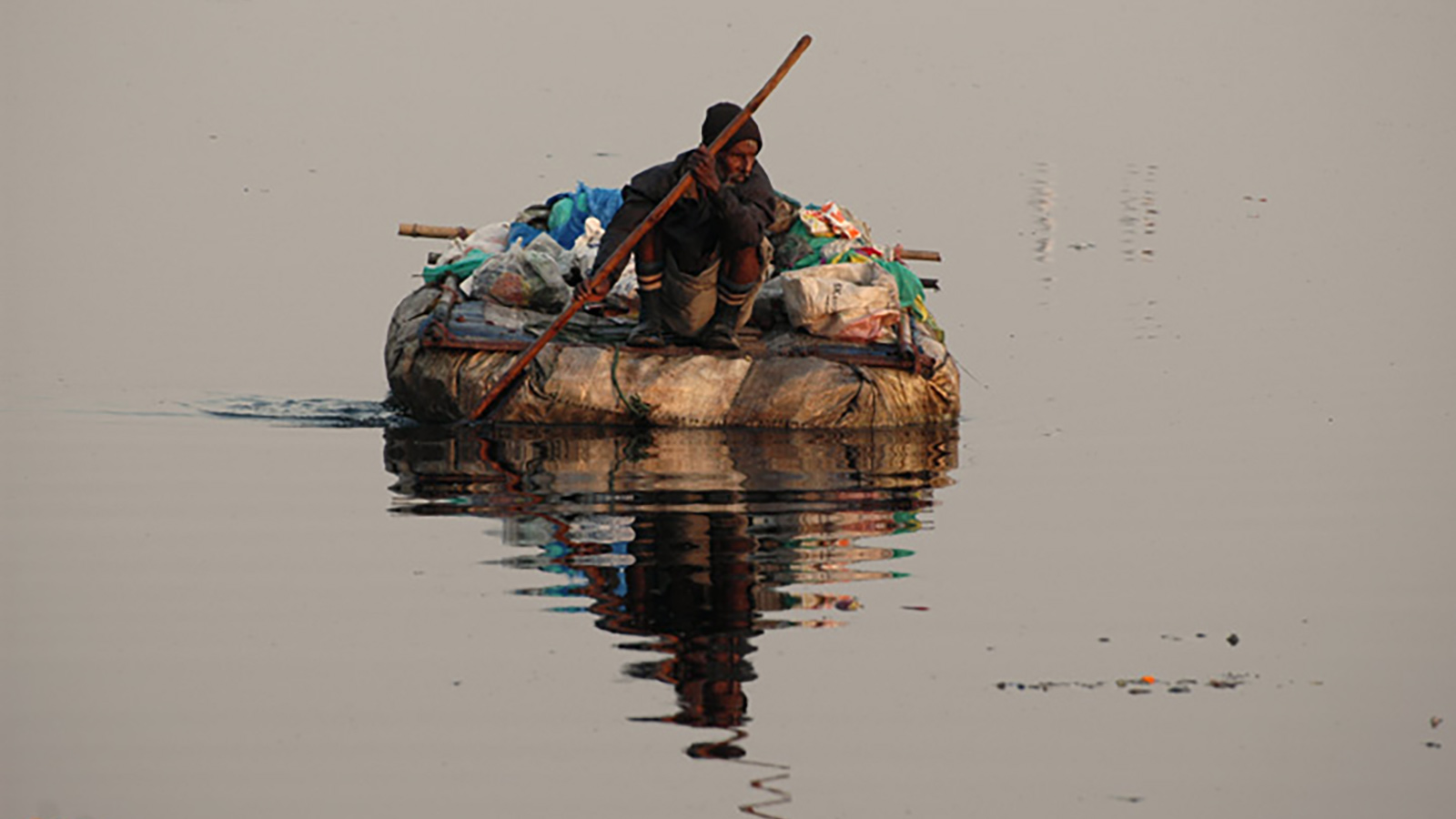
In this first section, we will provide an overview of the situation of waste pickers in Delhi by examining it within its environmental, social, and public health context. We will analyze the relationships between informal waste management, its environmental consequences, the exacerbating effects of climate change, and the associated impacts on public health, while drawing on a theoretical framework to better understand the systemic challenges faced by these populations.
A significant part of India’s current economy still relies on informal labor networks, at the center of which are waste pickers. For decades, this system has expanded exponentially among impoverished communities and the lower-middle class throughout the country. In New Delhi, the majority of these individuals belong to marginalized groups. Women waste pickers also face multiple forms of discrimination based on their gender, caste, religion, and the nature of their work. They lack government support and are often treated as though they are as disposable as the waste they handle.
These “environmental warriors” collect, sort, and redirect discarded materials toward productive uses. They help reduce the volume of landfills, limit methane emissions, and support resource conservation. Political neglect, social stigma, and even forced displacement continue to undermine their contribution to society, while the lack of legal recognition, social protection, and fair compensation keeps them trapped in precarious conditions. Recognizing the rights of waste pickers is therefore not only an ethical imperative but also an economic and environmental necessity for the city’s future. The gap between these workers’ vital environmental contributions and the lack of recognition they receive becomes particularly striking when considering the scale of their impact in Delhi. While they tirelessly divert thousands of tons of waste from landfills every day, systemic pressures such as privatization and social marginalization threaten both their livelihoods and the sustainability of the city’s waste management system.
In Delhi alone, informal waste workers recycle approximately 20 to 25% of the city’s daily waste production, amounting to around 10,000 metric tons each day. Their livelihoods are increasingly threatened as private companies expand their role in waste management, transforming waste into a commercial resource and gradually replacing those who have performed this work for decades. The waste sector itself is expected to reach a valuation of US$14 billion by the end of 2025, with a projected annual growth rate of seven percent, making recyclable materials increasingly valuable. Despite their essential role in collecting, sorting, and reintegrating materials into the economy, recycling workers remain marginalized. They provide a crucial environmental service while remaining socially and institutionally invisible. This highlights the need to examine both the environmental contributions and the profound health risks faced by these workers in New Delhi. To better understand how such essential work remains structurally invisible, it is necessary to situate waste picking within the broader economic and social framework of informality in India.
Theoretical Framework and Context
In India, the informal sector is not a marginal phenomenon but a central pillar of the national economy. Recent estimates suggest that informal activities account for approximately 45% of the country’s GDP and provide employment for more than 80% of the non-agricultural workforce. Within this vast sector, waste pickers play a crucial role in maintaining urban sustainability, particularly through their contribution to recycling supply chains. Studies indicate that nearly 80% of plastic collection in India is managed by unregulated networks, demonstrating the structural importance of informal waste recyclers within the circular economy.
Beyond its macroeconomic importance, the informal sector also operates through highly organized internal systems that shape how value is produced and circulated on a daily basis. Understanding the structure of Delhi’s informal waste economy also requires examining how materials move through its internal value chain, from their initial collection in the streets to their eventual reintegration into industrial production. After collection, recyclable materials typically pass through several stages of sorting and trading within Delhi’s informal waste system. Waste pickers first separate dry materials from wet waste, categorizing items such as plastic, glass, metal, and paper into broad groups. These materials are then further refined through additional levels of sorting based on factors such as color, thickness, or quality, before being transferred to small scrap shops, wholesalers, intermediaries and traders, or directly to recycling facilities, where they are reintegrated into productive uses. From there, materials move through informal supply chains toward small-scale recycling units, where they are transformed into reusable forms and reintroduced into manufacturing cycles in Delhi and surrounding regions.
WIEGO’s mapping report on informal waste workers reveals that waste pickers are present in at least 59 countries worldwide, with particularly large populations in India, Brazil, and other regions of Latin America and Asia. In India alone, estimates suggest that between 1.5 and 4 million people work as waste pickers, including approximately 250,000 in Delhi alone. The study highlights their significant contribution to urban waste management and recycling, as they often recover materials that municipalities are unable to process. In most cities, they work under precarious conditions, without access to protective equipment and while being exposed to toxic fumes, sharp objects, and hazardous substances. WIEGO’s findings also reveal a profound social injustice: while waste pickers provide essential environmental services, they face stigma, remain invisible in official statistics, and are particularly vulnerable to privatization and waste management reforms that restrict their access to recyclable materials. By mapping the global scale of this workforce, the research calls for their formal recognition and integration into urban waste management systems in order to ensure both environmental sustainability and social justice.
Within Delhi’s waste management system, this global reality takes a very concrete form, as waste pickers constitute the backbone of recycling by recovering resources that would otherwise be lost in landfills or incinerated. Without their contribution, a large portion of recyclable materials would be sent directly to disposal sites and remain untreated. Beginning their work in residential, commercial, and public areas, they collect, transport, and sort waste before bringing it to neighborhood sorting spaces or municipal dhalaos (community waste collection points). Unfortunately, many dhalaos were closed following the pandemic due to the privatization of municipal authorities and waste management systems.
This shift has widened the gap between street-based recyclers and those working within more formal structures employed by the city. Many unregistered waste workers are now denied access to residential and commercial areas, even for waste collection purposes. While some are employed by private companies or by the Municipal Corporation of Delhi (MCD), the majority remain unrecognized, working independently in the streets without official support or legal protection.
The replacement of traditional dhalaos—small neighborhood waste collection sites where waste pickers once sorted recyclable materials—with centralized mechanical compactors has profoundly transformed Delhi’s informal waste economy. Unlike accessible dhalaos, compaction sites are located farther away from residential areas and are controlled by municipal authorities or private contractors. As waste is now mechanically compressed and transported directly to landfills, waste recyclers are effectively excluded from the collection process.
As a direct consequence of this infrastructural change, informal recyclers are not permitted to access the new compaction sites established under Delhi’s privatized waste management system. These spaces are operated exclusively by municipal or contracted personnel, effectively criminalizing unauthorized access. In some areas, reports suggest that guards or supervisors demand informal payments from waste pickers attempting to recover recyclable materials. As a result, many have shifted their activities to open streets, markets, or large landfills such as Bhalswa and Ghazipur, where working conditions are significantly more dangerous.
This exclusion demonstrates how infrastructure modernization, when not accompanied by inclusive planning, can displace the very actors who are most essential to urban sustainability. This informal system is remarkably efficient: while the city formally recycles only 9% of its waste, nearly 95% of all recycling is carried out by the informal sector led by waste pickers [1]. Their contribution reduces municipal costs associated with energy consumption and waste disposal, lowers emissions by diverting waste away from landfills and waste-to-energy plants, and ultimately makes Delhi cleaner and healthier.
However, their livelihoods remain highly precarious: for example, waste pickers generally earn only—or, in most cases, less than—₹10,000 per month (approximately CAD $150), with privatization and mechanization reducing incomes by up to 30% following the introduction of compactors. Waste pickers are dispersed throughout Delhi’s neighborhoods and concentrated around major landfills such as Ghazipur, Bhalswa, and Okhla. Their situation reveals the extent to which they are essential to sustaining Delhi’s urban ecology and highlights the urgent need for policy reforms that ensure recognition, integration into municipal systems, safe spaces for sorting and recovery, as well as access to rights and protections.
This contrast between their environmental contribution and their social invisibility illustrates how urban sustainability in Delhi relies on a foundation of inequalities that remains largely overlooked in official discourse.
Waste recovery specialists themselves emphasize the contradiction inherent in their work, noting that they “help keep the city clean but must live in filth”. The challenges they face include insufficient access to safe working spaces, social stigma, harassment, health risks resulting from exposure to toxic waste, as well as the erosion of their incomes due to privatization and mechanization. In response, organizations have formulated what they refer to as the “4 Rs” of their demands: formal recognition and integration into waste management systems; systematic registration and documentation of workers at the municipal level; meaningful representation in waste-related policy-making; and guaranteed rights, including social protection.
In India, informal waste pickers play an essential role in reducing the environmental footprint of the country’s rapidly growing waste streams. Their livelihoods are increasingly threatened as private companies expand their role in waste management, transforming waste into a commercial resource and gradually displacing those who have carried out this work for decades. The International Labour Organization defines informal waste workers as individuals or micro-enterprises operating outside formal registration systems and official service provision structures. Together, these dynamics position waste picking at the intersection of environmental necessity, economic precarity, and structural exclusion within India’s informal economy.
Environmental Impacts
Air and Soil Contamination
Informal waste collection practices in Delhi simultaneously contribute to environmental protection and create health risks for workers. For example, the Bhalswa landfill, which is nearly as tall as the Qutub Minar, illustrates how poorly designed disposal sites can severely contaminate the environment. In the absence of protective lining, rainwater infiltrates through the waste, producing toxic leachate that carries heavy metals and dissolved solids into surrounding soils and groundwater. Over time, this pollution has spread into local aquifers, threatening both ecosystems and public health. Beyond water contamination, Bhalswa also represents a significant source of methane emissions, with frequent flare-ups that further worsen Delhi’s already hazardous air quality. These combined impacts demonstrate how inadequate waste management practices link environmental degradation to increased health risks for nearby communities. The localized impacts observed at Bhalswa reflect broader trends across Delhi’s waste landscape.
The decomposition of waste in Delhi’s landfills generates methane, toxic gases, and particulate matter that deteriorate air quality and intensify environmental pollution. Fires triggered by high concentrations of landfill gases release harmful smoke, while leachate from decomposing waste contaminates groundwater and nearby water bodies. With more than 10,000 tons of municipal solid waste generated every day, more than half of which ends up in open landfills, Delhi faces an immense ecological burden. These trends demonstrate how inadequate waste disposal practices and the lack of source segregation contribute to widespread soil and air contamination, harming not only surrounding communities but also workers who are exposed to these conditions on a daily basis.
Climate Change and Associated Impacts
Beyond local pollution and contamination, waste picking in Delhi is deeply connected to global climate change dynamics. Delhi’s waste pickers play a vital role in advancing environmental sustainability, as their efforts extend far beyond simple collection and sorting. By recovering reusable materials, they divert large volumes of waste away from landfills and incinerators, thereby reducing greenhouse gas emissions, conserving natural resources, and mitigating the broader impacts of climate change.
The improper disposal of the remains of human activities, particularly organic waste, leads to the release of methane, a powerful greenhouse gas, making the contribution of waste workers even more critical. Their work supports the circular economy by reintegrating discarded materials into productive cycles, reducing the extraction of raw materials, and maximizing resource efficiency. At the same time, they remain among the communities most vulnerable to climate disruptions, as floods, heat waves, and other extreme weather events directly threaten both their health and livelihoods.
This paradox—being both essential to climate change mitigation and disproportionately exposed to its consequences—highlights the urgent need to integrate waste pickers into climate justice frameworks and ensure that they receive recognition, protection, and fair compensation for their indispensable work. These climate-related dynamics translate into direct and growing risks in the daily lives of waste pickers.
Rising temperatures caused by climate change exacerbate the risks of heat-related illnesses and dehydration among waste workers, as increasingly frequent and prolonged heat waves intensify the already challenging conditions of their work. People living and working near landfills are particularly vulnerable, experiencing higher temperatures than surrounding areas and often facing the destruction of their homes during heavy rainfall or landslides. These realities, illustrated through the daily experiences of waste pickers in Delhi, highlight the deep interconnection between environmental degradation and socio-economic inequalities.
At the same time, grassroots organizations and waste worker unions, such as Basti Suraksha Manch and Safai Sena, are actively developing climate-resilient practices through training, advocacy, and collaborative partnerships with local authorities. However, these efforts require greater systematization and support from policymakers in order to become sustainable and replicable. Strengthening the climate resilience of waste workers involves not only disaster preparedness, climate-resilient housing, and community adaptation, but also their formal integration into municipal waste management systems, ensuring that their knowledge and expertise are recognized as essential assets in the fight against climate change.
Public Health Impacts
Toxic emissions and leachate from Delhi’s landfills have severe impacts on surrounding communities and informal waste workers who operate daily in such challenging environments. Prolonged exposure to contaminated air and water leads to respiratory illnesses, skin infections, and chronic health problems, particularly among those working at Bhalswa, Ghazipur, and Okhla. Fires, dust, and toxic fumes also worsen dehydration and heat-related stress. The public health crisis surrounding Delhi’s landfills reveals how environmental degradation and social vulnerability intersect to endanger marginalized populations. Many of these workers suffer from respiratory diseases and mental health challenges, as they are constantly exposed to landfill emissions. Heat exposure further intensifies these existing health risks.
Waste pickers are among the groups most vulnerable to prolonged heat exposure, as their work requires them to spend long hours outdoors in hazardous environments. This extended exposure increases the risk of heatstroke, cardiovascular complications, and chronic kidney disease, with these health consequences becoming more severe during periods of extreme temperatures. In New Delhi, informal waste workers at sites such as the Bhalswa landfill have reported reducing their daily food intake due to both declining incomes and increasing healthcare expenses caused by heat-related illnesses. Many are forced to choose between earning a minimal income—often ₹150–200 per day (CAD $2.25–3/day)—and avoiding potentially life-threatening working conditions.
Many workers experience dizziness, dehydration, and require medical treatment, with healthcare costs often exceeding their earnings and forcing some to stop working entirely during periods of extreme heat. Experts emphasize the urgent need for adaptation measures, including regular access to drinking water, shaded rest areas, and medical assistance near landfill sites. Although India has developed Heat Action Plans, their implementation remains inconsistent, leaving waste pickers exposed to daily risks that highlight the intersection between environmental stressors and social vulnerability.
Rising temperatures amplify existing health vulnerabilities while reinforcing broader social inequalities, highlighting the need for climate adaptation policies that incorporate social protection measures for informal workers. As extreme climate events, such as heat waves, are expected to increase in frequency and intensity under ongoing climate change, outdoor workers such as waste pickers represent one of the populations at greatest risk. Prolonged heat exposure can worsen pre-existing health conditions, increase the risk of occupational accidents, and, in severe cases, become life-threatening.
References
Arif Ahamad, N. Janardhana Raju, Sughosh Madhav, Wolfgang Gossel, Peter Wycisk. (2019). Impact of non-engineered Bhalswa landfill on groundwater from Quaternary alluvium in Yamuna flood plain and potential human health risk, New Delhi, India. Environmental Monitoring and Assessment, 191(3). https://www.sciencedirect.com/science/article/abs/pii/S1040618218300624
Associated Press. (2024). India: For garbage pickers, a miserable and dangerous job made worse by extreme heat. AP News. https://apnews.com/article/climate-change-heat-india-garbage-pickers-labor-heat-ba2664b6b651550141421466150229c1?
British Safety Council. (2025). India’s waste pickers: indispensable but invisible. https://www.britsafe.in/safety-management-news/2025/india-s-waste-pickers-indispensable-but-invisible
Newsclick. (2024). Delhi’s waste pickers: Integrating social protection, climate justice and labour rights. https://www.newsclick.in/delhi-waste-pickers-integrating-social-protection-climate-justice-labour-rights
The Guardian. (February 12, 2024). Revealed: the 1,200 big methane leaks from waste dumps trashing the planet. https://www.theguardian.com/environment/2024/feb/12/revealed-the-1200-big-methane-leaks-from-waste-dumps-trashing-the-planet
The Indian Express. (2024). Explained: The state of India’s informal economy. https://indianexpress.com/article/explained/explained-economics/explained-the-state-of-indias-informal-economy-9459931
The New Indian Express. (June 30, 2024). Extreme heat puts India’s garbage pickers at greater risk amid miserable working conditions. https://www.newindianexpress.com/nation/2024/Jun/30/extreme-heat-puts-indias-garbage-pickers-at-greater-risk-amid-miserable-working-conditions
WIEGO. (2021). Waste Pickers Global Map. [PDF]. https://www.wiego.org/wp-content/uploads/2021/08/Waste_Pickers_Map.pdf