
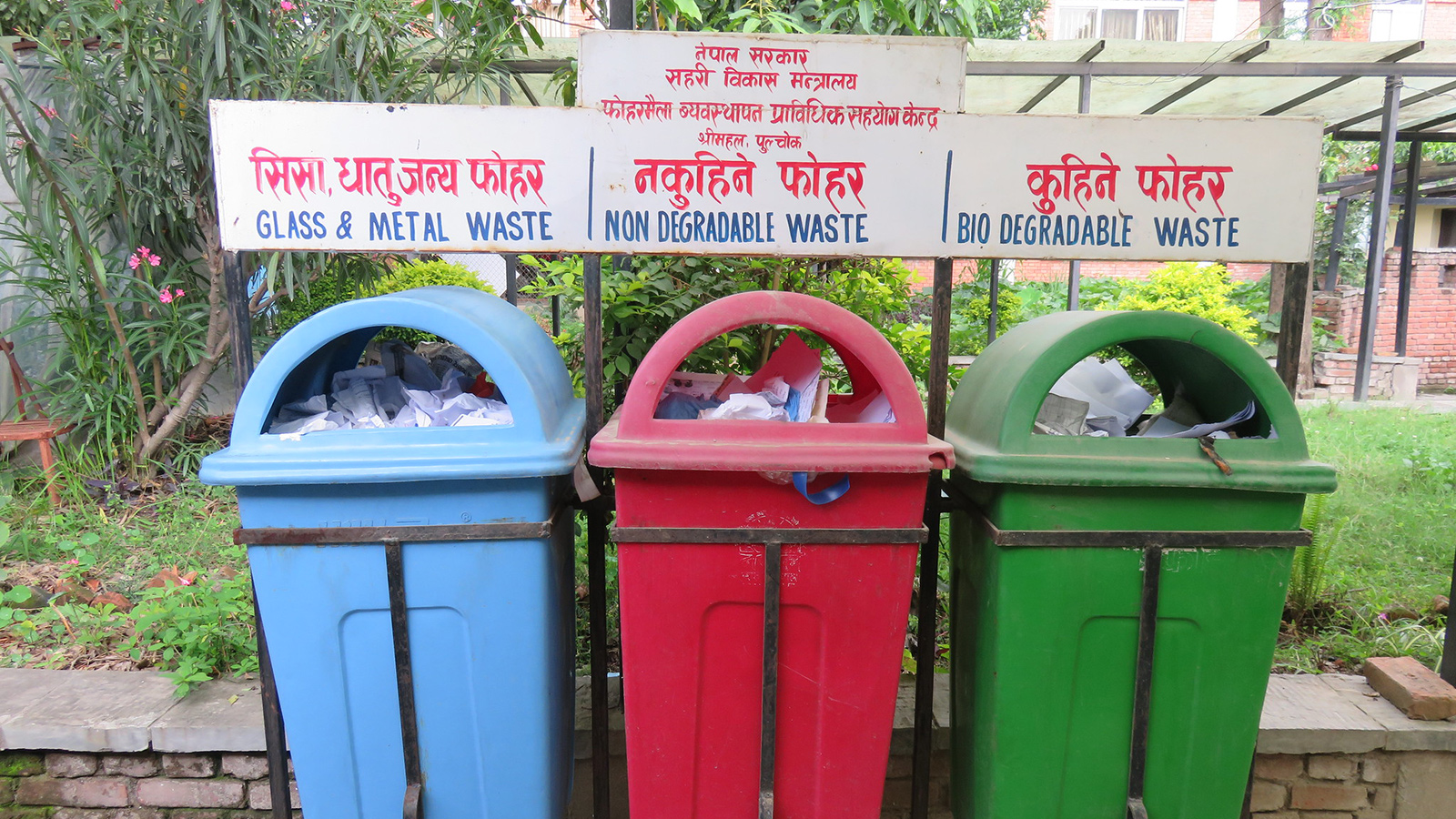
The Kathmandu metropolitan community faces significant challenges in waste management. Despite political will and the 2011 Solid Waste Management Act, the city struggles to implement best practices. Solutions include greater recognition of informal and semi-formal workers in the waste sector, better cooperation between private companies and the municipality, and investment in infrastructure.
In Kathmandu Metropolitan City (KMC), waste management is handled jointly by the municipal government and private companies. Nepal did not have legislation surrounding solid waste management until the 1980s, when basic legislation surrounding illegal dumping was formulated. In the 1990s, a dedicated policy for solid waste was developed, entitled the National Solid Waste Management Policy, from which the Solid Waste Management Act of 2011 was created1. Currently, municipalities are responsible for managing solid waste in adherence to this policy, but success has been limited. The policy promotes circular economic principles, including composting and recycling, as well as technological advancements to optimize waste processing, and awareness programs to encourage behavioral change (Solid Waste Management Act, 2011).
However, implementation of waste management practices has been lacklustre and dysfunctional. For example, the act mandates waste segregation at the source, but households simply have not followed through. KMC had planned to provide segregated waste bins to households and businesses, but this plan never materialized, leaving households and businesses with limited options for waste segregation. As of 2008, 84 % of households did not segregate their waste2.
Additionally, waste is routinely mixed by collectors themselves, which is a practice that would undo any effort made by households3. One major problem within KMC is the complexity of the waste management system, which involves a mix of the government, private companies, and informal workers. In most wards, waste is collected by private companies in cooperation with KMC 2 to 3 times a week, for which households and businesses pay a monthly fee, a practice that has increased over the years4. These private companies are generally unregulated, operating without licenses, which results in profit-driven practices. For example, private companies refuse to service communities that cannot pay the fee or are difficult to access by truck, leaving some with uncertainty regarding waste collection. For reasons such as this, there is a collection gap of about 13%, which has resulted in waste being disposed of in the river or forests5. Coupled with this issue is a lack of awareness and guidance on the part of the government. Despite the Solid Waste Management Policy’s emphasis on public awareness, the majority of citizens have reported receiving little to no information about proper waste disposal6.
Additionally, in a minority of wards, the city collects waste without charging fees, which creates inequality in that richer areas of the city enjoy more reliable garbage collection7. Waste is collected either on trucks or carts owned by the KMC, many of which are left unused or co-opted by private companies who charge households for collection. Trucks operated by both private companies and KMC are poorly maintained and frequently produce leakage and odor8. Trucks also do not have a set route, which can increase the uncertainty within communities9. Once waste is collected, it is transported in large trucks to transfer stations such as Teku, where it is sorted by informal or semi-formal waste workers, then taken to landfills such as Sisdol, Gokarna, and Banchare10. Currently, Banchare is the only active landfill, as Sisdol and Gokarna have exceeded their capacity. All landfills that service KMC experience leachate leakage, methane buildup, and improper waste segregation, with organic waste being the majority of the waste at these landfills. Toxic leachate has seeped into the soil and water bodies in surrounding areas, exacerbating the already existing pollution problems11. Despite these glaring issues, private companies are essential to the waste management system and are often constrained by a combination of lack of funding and a high demand for services.
Overall, the implementation of the SWM Act has not been effective. KMC struggles with disorganization as well as a lack of facilities to process compost and recyclables, which make up the majority of waste in KMC. With proper waste segregation and functional processing centers, KMC’s waste management situation could improve drastically and move closer toward the ultimate goal of transitioning to a circular economy; however, due to funding and coordination issues, the system is currently stagnant.
According to the United Nations Development Program (UNDP), the circular economy is a system in which production, consumption, and disposal are optimized to limit environmental damage12. Most societies operate under a linear economy, characterized by destructive production practices, irresponsible consumption, and careless disposal of waste. Under the circular economy model, goods are not overproduced; production has a minimal environmental impact, and goods are designed to last. Consumers buy with intention, and repair/reuse their purchases as much as possible. Any waste that is generated is recycled; for example, organic waste is used to generate biogas energy13.
In the context of KMC, the idea of a circular economy is still in its infancy. The Solid Waste Management Policy primarily focuses on reducing waste generation, without addressing the production issues that lead to increased household and business waste. The policy states that the country will “carry out various works to minimize the generation of the solid wastes” (Solid Waste Management Act, 2011); however, this vague language indicates a lack of institutional understanding about how to transition to a circular economy practically and a lack of willingness to do so. Similarly, while the policy emphasizes the importance of waste recycling to create compost or energy, it fails to describe concrete methods to implement the necessary facilities. The policy also does not provide a plan for handling non-organic recyclable waste, such as plastic and metal, instead focusing solely on the recycling of organic waste. The majority of these issues can be traced back to budget mismanagement, as KMC spends around 38.4% of its annual budget on waste management, which is well above the World Bank’s recommended 0.5% of GNP allocation to the sector. Yet, illegal dumping, dysfunction in collection, and poor landfill conditions still exist14. While these issues persist, KMC can begin on the path towards a circular economy in spite of systemic failures, specifically through better supporting the private sector.
There is a noticeable gap in the literature regarding the pros and cons of private waste companies and their effect on the circular economy in Nepal, with most information on the subject being an excerpt from a larger study on general waste management in the country. However, there have been several comparative studies on waste management systems in the West versus the KMC that show how the systems within KMC could benefit from adopting methods from countries such as Australia, EU member states, and the USA. For example, the municipality in Victoria has vehicles dedicated to landfill waste, compost, and recycling, with private companies and the municipal government working together to service a broader area. Victoria also has more landfills, operated by both the city and the private sector, complete with processing facilities. There is also an increased emphasis on pollution/waste segregation education within schools and the general community15.
Similarly, in the US, landfills are built and maintained in cooperation with the private sector, and liners to prevent leachate seepage are considered essential. The private sector was also heavily involved in legislation surrounding waste management, ensuring that policies remain aligned with the goals of companies in this sector. This resulted in the construction and maintenance of landfills across the country, which has drastically improved waste management issues, such as unregulated landfills16.
In the case of the EU, the government has mainly been responsible for waste collection, although partnerships with the private sector are increasing. Where the EU sees success is in its comprehensive waste management policy, which starkly contrasts with that of Nepal. The policy targets the beginning of the waste cycle, making producers responsible for the waste their product produces, a concept known as “extended producer responsibility (EPR)”. This policy places producers in charge of managing/minimizing the waste generated from their products, meaning that they are expected to cover the costs associated with processing the waste17. This policy encourages environmentally conscious production, which has a major impact on waste management. EU countries are also mandated to “reuse or recycle 50% of household waste that includes at minimum discarded paper, metal, plastic”18, which shows that strict policies are effective tools in promoting the circular economy. While the KMC and Nepal in general could benefit from adopting similar models, developing countries like Nepal experience a very different set of challenges than countries like the USA, Australia, and members of the EU.
Therefore, it is equally important to explore successful waste management systems in countries whose context is comparable to that of Nepal. Indonesia is an example of a developing Southeast Asian country that has experienced pollution and poor waste management. While Indonesia, like Nepal, struggles with waste segregation, fragmented waste collection, and unsanitary landfills, the city of Surabaya has found success through directly supporting communities19. In coordination with private companies, the municipal government holds competitions between villages, awarding the cleanest villages in a ceremony. Several community members are appointed as leaders of the program and work to monitor and educate fellow community members on proper waste segregation and handling. The program has become very popular in the city, with over 1200 communities participating20. The city also implemented citizen-run ‘garbage banks’ where community members can sell certain waste products to the bank, which then sells that trash to private companies. The city has also made an effort to legitimize the work of informal waste workers by forming an association and ultimately recognizing them as a part of the waste system21.
In Nepal, particularly in the KMC, informal waste workers play a significant role in the waste management system; however, numerous studies on the subject have revealed that informal waste workers face hazardous working conditions, social stigma, a lack of legal protections, and limited access to basic services. Many informal or semi-formal workers are from marginalized and lower caste communities, such as Dalit and migrants. Workers have no rights and protections, make a low salary, and face stigmatization and humiliation. Workers gather at high waste yield locations, such as tourist destinations, and sell gathered waste to wholesalers. They also scavenge at landfills and sort waste for private companies. Due to the informal nature of the work, these workers work in unhygienic conditions and lack training on handling waste safely22. These workers provide an invaluable service to the waste industry, since they contribute greatly to material recovery. While the KMC has the potential to recycle 44% of materials such as textiles and plastic, only 8% is being leveraged by private companies and informal workers23. Informal workers manage 10% of total waste, and 25% of recyclable material is diverted from landfills thanks to their work24. With no formal segregation practice during waste collection by both the KMC and private companies, informal and semi-formal workers are essential to the waste management system25. They contribute around $2.4 million annually to the economy, operating without regulation or taxation, which keeps costs low but at the expense of worker safety and social protections. Despite understanding the importance of informal and semi-formal workers, the government refuses to provide them with social security and health benefits. These workers are essential to the waste management system and contribute to the circular economy by picking out waste that can be used for another purpose.
They know what can be reused and how, making them an integral part of understanding how to implement circular economy policies26. Due to the issues above, workers often find themselves in precarious situations, for example, in Kathmandu’s extremely disorganized and dangerous landfills, hospital waste is mixed with general waste, creating huge negative effects for both the environment through soil and water contamination and methane emissions, and the scavengers who pick waste from landfills27. In such situations, workers are exposed to risks such as getting cut by glass or needles or accidentally handling biohazardous material. Due to a lack of training and education, these workers are unaware of longer-term issues such as disease from chemical exposure and bloodborne illnesses. If not in landfills, they often push their bikes along the roadside, exposing themselves to the dangers of traffic as well. Some workers have reported social discrimination and ostracization by their employers, families, and general society due to their work28.
To advance a circular economy in Kathmandu Metropolitan City, it is essential to formalize and support informal and semi-formal waste workers by providing legal recognition, social protections, and safe working conditions, potentially through a collective model inspired by Surabaya. Financial incentives, tax breaks, and land access should be offered to companies engaged in composting and recycling, alongside the introduction of Extended Producer Responsibility policies to place more responsibility on producers. Waste segregation at the source must be strictly enforced through initiatives like public education, color-coded bins, and integration into school curricula. Additionally, collaboration between municipalities and private companies should be prioritized, since this is key to expanding waste collection routes and improving efficiency. It would also make developing infrastructure, such as transfer stations and compost facilities, a more realistic goal. Along with this, investments in hygienic sorting centers, regulated landfills, and local recycling plants, along with the expansion of biogas initiatives, are necessary to enhance environmental sustainability and improve conditions for workers. These combined efforts can help create a more environmentally resilient waste management system in KMC that aligns with sustainable principles and moves the city closer to a circular system.
References
1. Chowdhury, Moe. (2016). Legal and Institutional Framework for Sustainable Solid Waste Management. Dans Wong, Jonathan W. C., et al. (Eds), Sustainable Solid Waste Management. (653-691). DOI : 0.1061/9780784414101.ch21
2. Alam, R., Chowdhury, M. A. I., Hasan, G. M. J., Karanjit, B., & Shrestha, L. R. (2008). Generation, storage, collection, and transportation of municipal solid waste – A case study in the city of Kathmandu, capital of Nepal. Waste Management, 28(6), 1088–1097. https://doi.org/10.1016/j.wasman.2006.12.024
3. Urban Development Ministry. (2015). Solid waste management of Kathmandu Metropolitan City: Environment audit report.
4. Alam, R., Chowdhury, M. A. I., Hasan, G. M. J., Karanjit, B., & Shrestha, L. R. (2008). op. cit.
5. Urban Development Ministry. (2015). op. cit.
6. Dangi, M., Cohen, R., Urynowicz, M. & Poudyal, Khem. (2009). Report: Searching for a way to sustainability: Technical and policy analyses of solid waste issues in Kathmandu. Waste management & research: the journal of the International Solid Wastes and Public Cleansing Association, ISWA. 27. 295-301. https://journals.sagepub.com/doi/10.1177/0734242X08094951
7. Urban Development Ministry. (2015). op. cit.
8. Ibid.
9. Alam, R., Chowdhury, M. A. I., Hasan, G. M. J., Karanjit, B., & Shrestha, L. R. (2008). op. cit.
10. Sapkota, A. (2013). Managing Municipal Solid Waste in Kathmandu: Observation and Policy Recommendation. Da Ayit Wa Nepal Public Service Fellowship Summer 2013. https://www.daayitwa.org/storage/archives/1582196359.pdf
11. Shahi, P. B., Ghimire, S., Ranabhat, A., & Adhikari, N. (2023). Solid Waste Management: A Case Study of Kathmandu Valley. Proceedings of 14th IOE Graduate Conference. https://conference.ioe.edu.np/publications/ioegc14/IOEGC-14-204-PS3-005-164.pdf
12. UNDP. (2022). What is the circular economy, and why does it matter?. https://climatepromise.undp.org/news-and-stories/what-is-circular-economy-and-how-it-helps-fight-climate-change
13. Ibid.
14. Dangi, M., Cohen, R., Urynowicz, M. & Poudyal, Khem. (2009). op. cit.
15. Douglas, Kylie & Ionescu, Daniela & Mainali, Bandita & Petrolito, Joe. (2015). Integrated Waste Management – Technology Transfer Between Australia and Nepal. Environmental Science and Sustainable Development (pp. 101-108). https://doi.org/10.1142/9789814723039_0014
16. Chowdhury, Moe. (2016). Legal and Institutional Framework for Sustainable Solid Waste Management. op. cit.
17. Ibid.
18. Ibid.
19. Damanhuri, E., Handoko, W., & Padmi, T. (2014). Municipal Solid Waste Management in Indonesia. In Municipal Solid Waste Management in Asia and the Pacific Islands (pp. 139–155). Springer, Singapore. https://doi.org/10.1007/978-981-4451-73-4_8
20. Ibid.
21. Ibid.
22. London, J. K., Adhikari, J., & Robertson, T. (Eds.). (2025). Environmental justice in Nepal: Origins, struggles, and prospects. London: Routledge. https://doi.org/10.4324/9781003371175
23. Labra Cataldo, N., Oyinlola, M., Sigdel, S., Nguyen, D., & Gallego-Schmid, A. (2024). “Waste Management in Nepal: Characterization and Challenges to Promote a Circular Economy”. Circular Economy and Sustainability, 4(1), 439–457. https://doi.org/10.1007/s43615-023-00283-0
24. Dangi, M. B., Malla, O. B., Cohen, R. R. H., Khatiwada, N. R., & Budhathoki, S. (2023). “Life cycle assessment of municipal solid waste management in Kathmandu city, Nepal – An impact of an incomplete data set”. Habitat International, 139, 102895. https://doi.org/10.1016/j.habitatint.2023.102895
25. Labra Cataldo, N., Oyinlola, M., Sigdel, S., Nguyen, D., & Gallego-Schmid, A. (2024). op. cit.
26. Ibid.
27. Dangi, M., Cohen, R., Urynowicz, M. & Poudyal, Khem. (2009). op. cit.
28. Sapkota, S., Lee, A., Karki, J., Makai, P., Adhikari, S., Chaudhuri, N., & Fossier-Heckmann, A. (2020). “Risks and risk mitigation in waste-work: A qualitative study of informal waste workers in Nepal”. Public Health in Practice, 1, 100028. https://doi.org/10.1016/j.puhip.2020.100028