
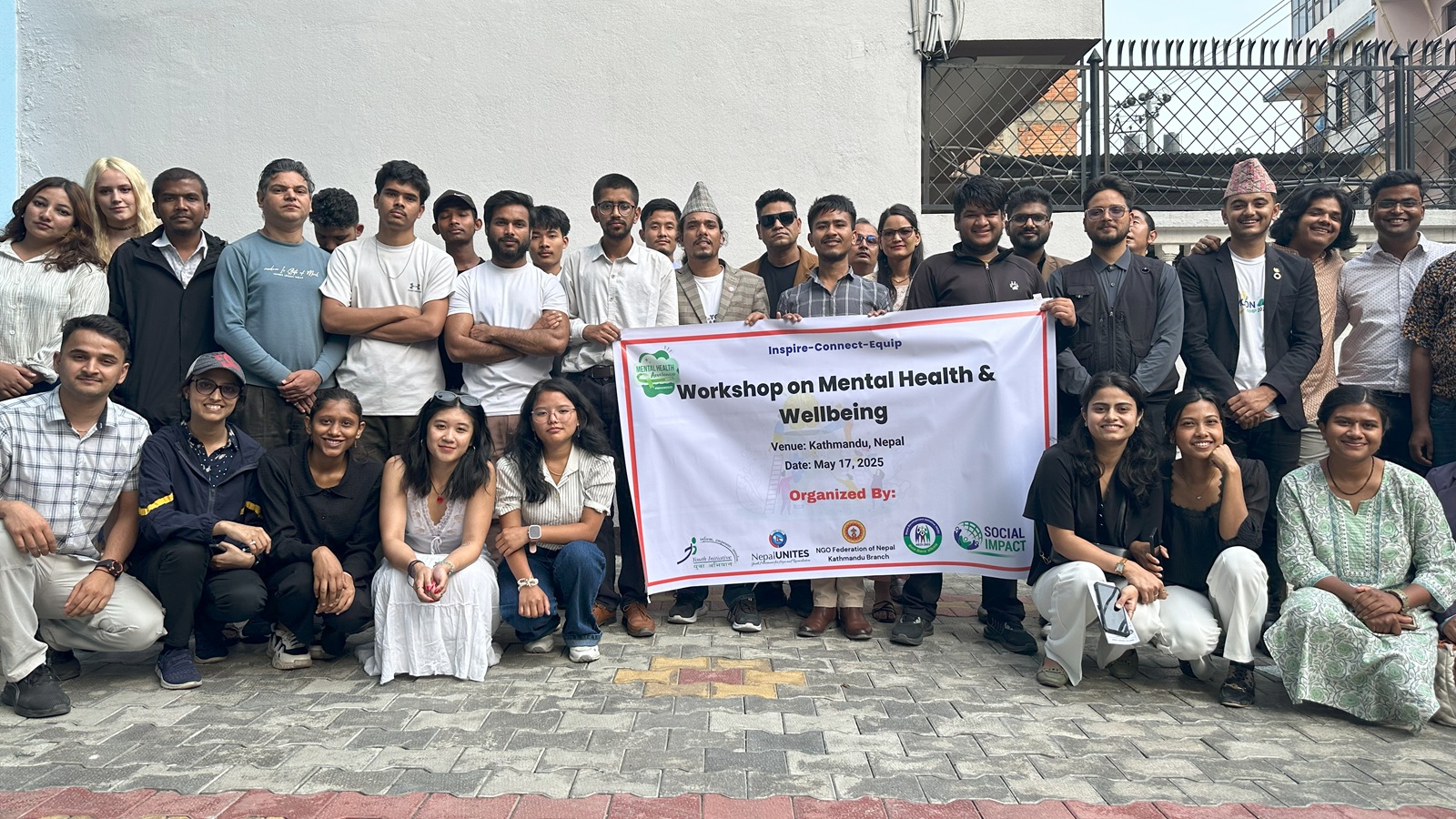
The mental health of young people in Nepal suffers from a public health system that does not sufficiently recognize the importance of treating this issue as a political priority. On May 17, 2025, Nehal Singh and Susmita Yadav attended a workshop on this topic co-organized by several associations, including the Nepal Development Initiative (NEDI).
Authored By Susmita Adhikahari (Yadav); Nehal Kumar Singh
Mental health conversations are slowly finding their way into Nepali society, but for many young people, these conversations still feel like an unusual concept. This May, in the spirit of Mental Health Awareness Month, we hosted a youth mental health workshop in Kathmandu to change that. With support from Youth Initiative core team i.e., Ganga Bahadur Gautam (Pawan), general Secretary Yogesh Kaphle and Secretary Susmita Adhikari (Yadav) in collaboration with NFN (NGOs Federation of Nepal), Nepal Unites, and NEDI (Nepal Development Initiative), the session brought together students, social workers, healthcare professionals, and community members to talk openly about something many of us have experienced but rarely voice. It’s no secret that Nepal is struggling to meet the mental health needs of its population, with fewer than 66 psychiatrists for nearly 30 million people1. Add cultural stigma, low awareness, and lack of resources to the mix, and it becomes clear that grassroots efforts like ours are not just important, they’re urgent.
We designed the workshop to be relatable and interactive, something more than just a lecture from the slides. Dr. Gopal Dhakal, a renowned psychiatrist, joined the session and played a key role in deepening the conversation, helping participants navigate complex emotional and psychological themes with greater understanding. Ravi, a passionate youth, musician, law student, and mental health advocate, also joined our campaign and lifted the energy in the room with his music, offering a much-needed moment of lightness during what was an intense and emotionally charged discussion. Instead of clinical definitions, we used simple metaphors: depression as a heavy fog, anxiety as a constant “what if” alarm, and psychosocial dysfunction as a glitchy Wi-Fi signal. Participants responded well to this approach. Many told us it was the first time they really understood what these terms meant or felt comfortable admitting that they related to them. With gratitude journaling, small group discussions, and role-playing, we created a space where people could be vulnerable, laugh, and feel seen.
We conducted a survey during the session that gave us deep insights. While 58% of youth said mental health is “very important,” only 21% had ever reached out to a mental health professional. About 46% of participants had experienced anxiety, 31% had faced depression, and 17% had thought about suicide at some point in their lives. Most shockingly, only 3 out of 9 respondents knew Nepal’s mental health helpline number 1166 or any of the other free support lines like those from TPO Nepal, Patan Hospital, or CMC Nepal. These numbers confirm what we suspected: awareness is growing, but access and education still have a long way to go2. Our findings also mirror those of Hassan’s, whose qualitative research on adolescent depression in Nepal revealed similar patterns where stigma, school pressure, and lack of services delay help-seeking behavior in young people. The alignment between our small workshop data and their larger academic study reinforces how widespread and urgent these mental health challenges truly are.
When we looked closer at how young people cope with stress, the data showed most rely on nature walks, journaling, prayer, or talking to friends. Only 1 in 12 respondents mentioned seeking professional help. These are all valuable ways to manage emotions, but they shouldn’t be the only options, especially for youth experiencing a crisis. A large number of participants also said they wouldn’t know where to start if they or a friend needed urgent help. There were other concerns, like how to address conversations about mental health with parents and grandparents, as they tend to have a dismissive attitude towards it. It’s clear that while the conversation around mental health has started, support systems haven’t caught up yet.
The stories we heard during the workshop gave even more depth to the numbers. Students talked about exam pressure, the weight of family expectations, and the toxic comparison culture driven by social media. Many felt they couldn’t talk to their parents or elders about mental health. One person said, “It’s easier to suffer in silence than to explain myself to people who won’t understand.” Others said this was the first time they had heard others talk about feeling the same way. These shared stories reminded us how powerful it is when young people are simply given the space to talk without fear. Their reflections also echo what Tamang et al. (2022)3 found during the COVID-19 pandemic: young people in Nepal experienced increased isolation, stress, and emotional disconnect, often with limited outlets for expression. The emotional honesty in our session reinforces their findings, showing that the psychosocial impact of societal and family expectations continues well beyond the pandemic.
Participants didn’t just share problems; they offered solutions too. They want mental health education in schools, government-supported counselling programs, and safe online platforms where they can ask for help anonymously. They also asked for youth to be included in planning and policymaking. “Talk to us, not about us,” one participant said, asking NGOs and institutions to stop assuming what youth need and start co-creating programs with them. Their ideas mirrored recommendations from researchers and global health experts, but they were grounded in personal experience, which made them all the more powerful. In fact, Luitel, et al., (2015)4 have emphasized the importance of embedding mental health education in both school curricula and community centers. I second the approach as it aligns perfectly with what our participants were calling for. This connection between local voices and academic insight shows that the solutions youth are asking for are valid, as well as evidence based.
We also discussed digital solutions, and platforms like Dialogue and Headversity came up as promising tools. These apps offer virtual counselling, mental fitness training, and practical tools for managing stress, all at their fingertips. In a country like Nepal, where stigma still prevents many from walking into a counselling center, having access to a private, culturally tailored digital platform could be game-changing. If platforms like these could be translated and adapted for Nepali youth, they could offer a bridge between awareness and action. Pairing digital solutions with grassroots programs could be one of the smartest ways forward. NGOs have already laid the groundwork. Organizations like TPO Nepal, CMC Nepal, and ECTC have been providing free, confidential support for years through phone lines and in-person outreach. They’re doing incredible work, but they’re underfunded and can’t reach everyone. Our participants welcomed these resources when we shared them during the session, especially the helplines like 9847386158 or 16600185080. These numbers need to be posted in schools, bus stops, and classrooms, not just websites. But for this to happen at scale, the government needs to step in with long-term investment.
And that brings us to the role of government. Right now, mental health isn’t seen as a policy priority in Nepal. That needs to change. We need education ministries to add emotional literacy to school curriculums, health ministries to fund more professionals, and infrastructure to bring these services outside Kathmandu. Foreign aid can play a part too, but it needs to fund sustainable systems, not just one-off programs. Nepal doesn’t lack ideas or motivation; it lacks structural support and coordination. As Luitel et al. (2015)5 argue, long-term mental health improvements require multi-sectoral collaboration across education, health, and community institutions backed by policy and funding. Their research supports exactly what our workshop revealed: when government systems invest in integrated, youth-centered mental health education, the ripple effects can transform both awareness and access. This workshop showed us that we don’t need a fancy budget to make a difference. What we need is intention, inclusion, and empathy. By blending storytelling, relatable language, and practical resources, we were able to connect with youth on their terms. And once we did that, they opened up not just about their struggles, but about their hopes for a better, more supportive system. That’s what mental health work should be about: connection first, then change.
We urge everyone who holds power in government, in NGOs, in donor agencies, we need you to hear this: youth mental health in Nepal is a growing epidemic, and the time to address it is not tomorrow, it’s now. What we’re seeing is not just individual struggle; it’s a systemic failure to support an entire generation’s emotional well-being. The youth have shown us they are ready to talk, lead, and heal, but they can’t do it alone. We need your commitment to fund programs, reform policies, and support grassroots efforts that make mental health support visible, accessible, and equitable. This movement doesn’t end with one workshop; it begins there. Since great power comes with great responsibility, can we use it to create conditions for others to thrive?
References
1. Singh R, Gupta AK, Singh B, Basnet P, Arafat SMY. (2022). “History of psychiatry in Nepal”. The British Journal of Psychiatry Int. doi: 10.1192/bji.2021.51
2. Hassan, E., Prakash, B., Magar, J., & Luitel, N. P. (2022). “Retrieved from Community perspectives on the implementation of a group psychological intervention for adolescents with depression: A qualitative study in rural Nepal”. Front. Psychiatry. 10.3389/fpsyt.2022.949251
3. Tamang, D. M., Khadka, D. D., Poudel, D. J., Khatri, D. M., & Chemjong, D. D. (2022). “Psychosocial Impact of COVID-19 and Related Policy Provisions in Nepal”. Policy Research Institutue. https://kms.pri.gov.np/dams/pages/download_progress.php?ref=23197&size=&ext=pdf&k=1e7b01627a
4. Luitel, N. P., Jordans, M. J., Adhikari, A., Upadhaya, N., Hanlon, C., Lund, C., & Komproe, I. (2015). “Mental health care in Nepal: current situation and challenges for development of a district mental health care plan”. Conflict and Health 9, 3. https://conflictandhealth.biomedcentral.com/articles/10.1186/s13031-014-0030-5
5. Ibid.