The emergency context that Colombia has experienced in recent months has mobilized international solidarity. Alternatives has been particularly concerned by the situation. In this context, coordination actions by different social actors in Quebec led to the elaboration of a human rights verification mission in which Alternatives actively participated from November 25 to December 8.
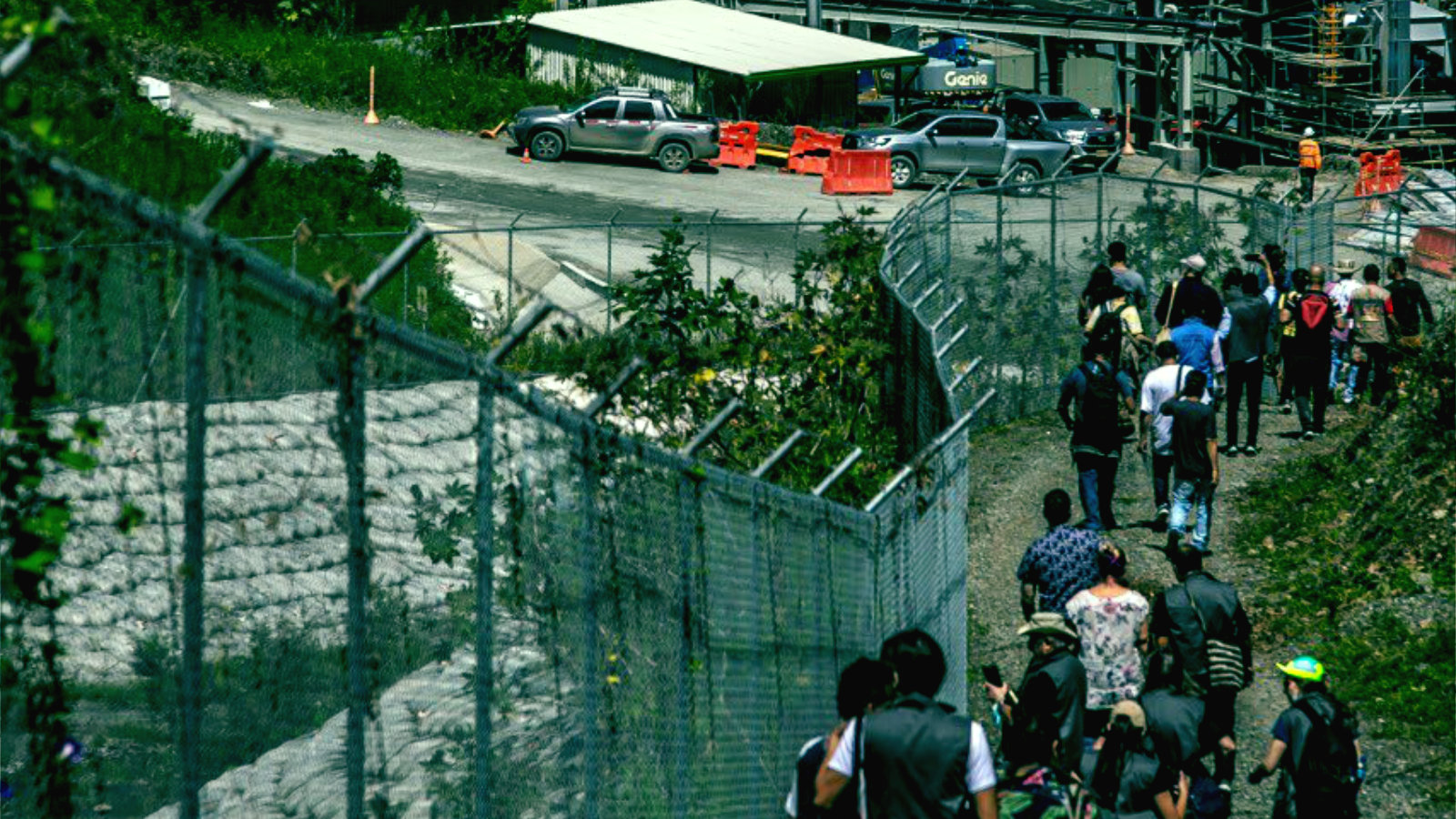
Since last week, the delegation has visited different regions of the country to listen to social movements and different civil society groups regarding allegations of human rights violations related to the social explosion of recent months and the mining and energy megaprojects in which Canada has investments in Colombia.
During its visits, the commission visited the cities of Bogotá, Medellín, Cali, Popayán and Neiva to speak with social organizations in relation to human rights violations committed by the forces of law and order during the social explosion and in the Gramalote and Hidroituango megaprojects, financed in part by Canadian investors and companies. Despite the peace process, there is growing tension between the people, who are demanding to preserve their way of life in the face of the construction and operation of large mining infrastructures, and the forces of law and order.
The megaprojects, which are the most important units of territorial planning of globalization, are defined in global forums, according to the modality of public-private partnerships financed by public and private resources, and it is the communities and local governments that suffer their consequences without having a real participation in the design, planning, nor in the economic and social benefits derived from these projects.
Thus, the changes brought about by neoliberal globalization have been more profound than a simple administrative and territorial reorganization of states. The tensions between geographical scales are manifested in the changes in the geometry of power between actors at the global, national, and local scales brought about by globalization. On the one hand, this shift empowers global actors, primarily transnational corporations, and on the other hand, it restricts and excludes local community actors from power and participation in decision-making.
Protesting actors at the local level are demanding real and direct participation in the democracy, development and planning of their territories. The next elections in 2022 will be very important. The proposal of the left led by Gustavo Petro seems to be consolidating itself as a real option for power.
The delegation is composed of : Simon Pierre Savard-Tremblay, Member of Parliament for Saint-Hyacinthe-Bagot and Bloc Québécois spokesperson on international trade, Juliana Fumagalli, former mayor of Villeray in Montreal, Denise Gagnon, former director of international solidarity for the Quebec Federation of Labour, Yves Carrier, coordinator of the Carrefour de solidarité pour un monde ouvert (CAPMO), Andrés Muñoz, representative of the Salvador Allende Foundation of Montreal, Geneviève Dorais, co-director of the Laboratoire interdisciplinaire d’études latino-américaines (LIELA) and professor in the history department of UQAM, Salvador David Hernandez, researcher with Alternatives, Javier Fuentes Bernal, consultant in gender and member of Chimbites and AGIR Montreal, Chloé Gravel, representative of the Colombia Solidarity Project PASC, Walter Mora of Solidaridad Colombiana and Mario Gil, sociologist and mobilization officer of CAPMO.
– – –
CAPMO is still fundraising to support the various partners of this initiative in Colombia. If you decide to support the mission through financial aid, we invite you to do so at the link below. The funds raised will be used for in-country transportation, logistics, and mission follow-up.