
Last January 14th was the 11th anniversary of the Tunisian revolution. For this occasion, we share a text written by Safa Chebbi on August 15th 2021, in a very particular context. The analysis is still relevant today.
While going through my belongings, I found this card that I had in Egypt around May 2013 during the pre-“election” period of El Sissi. The map reads in Arabic: Abed Fatah El Sissi, Address; Ministry of Defense, Profession; Savior of Egypt. On the reverse side of the map: The army, the police and the people, hand in hand.
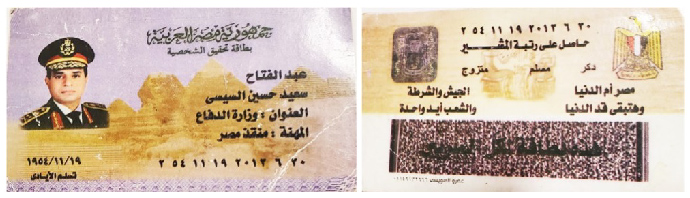
I have so many memories of that period, I remember how the frustration was very palpable in the streets of Cairo and that in talking to many Egyptians, how El Sissi was almost the only existing and realistic glimmer of hope to improve the situation of the country.
I also remember that during the first weeks of El Sissi’s coup in August 2013, it was unacceptable in the public space to question the “will of the people” that was then expressed in the streets. Not to mention all the euphoria of social networks in my closest circles where it was unacceptable to problematize the situation or go against the “will” of the Egyptian people. Even the mere utterance of the word “coup” was considered high treason at that time!
Today, eight years later, the repression in Egypt is more severe than ever and the socio-economic situation has worsened compared to the first years of the revolution.
I mention these images because I have the impression that I have lived through a similar context in Tunisia, where the people’s frustration and anger have been gradually growing over the past few years, and where suddenly, by the grace of heaven, a “savior” with superpowers would have taken us out of this unfortunate situation. We can certainly make several nuances between the situation of Tunisia and Egypt and that at different levels (the place of the army in the governance, the type of political regime in place, the history of the country …), but an authoritarian process is always the same, because it is gradually installed by adjusting and adapting to the local peculiarity of each country.
It is also important to note that an authoritarian process does not occur when everything is going well, it arises in a context of acute crises, when the traditional political class becomes incapable of managing the affairs of the dominant social order, and on the other hand, when the mass movements are unable to achieve a radical change so that all avenues of change are paralyzed in both directions. This leads the middle class, seeing their bourgeois ambitions aborted and favoring a state of social tension, to mobilize around Bonapartist tendencies in which they hope to stop the deterioration of their situation without risking igniting a new revolutionary flame.
In Tunisia, we can see that for the last ten years, the alliance between Ennahda and RCD (and their derivatives) has been able to continue thanks to the support of the bourgeoisie and the support of foreign colonial powers (EU, USA, and their allies). During this time, the popular classes have had no choice but to rise up, but without being able to organize themselves sufficiently to seize power and defend their interests, thus reinforcing their political, social, and economic marginalization. Today, the balance of power has shifted.
It is in this precise context that the bourgeoisie and the colonial powers with their instruments have been quick to reinvent themselves and propose new forms of consensus, or a new social order to defend their interests, which undoubtedly means exploiting more to the detriment of the popular classes, plundering the country’s wealth. The example of the IMF and its local banking brokers pushing for more privatization and foreign investment is one of many.
July 25 is part of this process, and Kaïs Saïd’s coup d’état is a dangerous precedent in the history of post-revolution Tunisia. Based on his own interpretation of an article of the constitution, in this case Article 80, he suspended the activities of parliament, lifted parliamentary immunity, and dismissed the government, appointed himself as public prosecutor and threatened to punish anyone who went against these measures. The purely legalistic and constitutionalist discourse around the interpretation of this article is irrelevant in this context, because in reality, the monopolization of the majority of powers by one man is an implacable reality. Moreover, the judiciary could also have been under his control if there had been not resistance.
It is also true that these decisions were received with great joy by the popular masses, because to remove the cursed political faces, especially the Islamists, who have greatly contributed to the rotting of the social and political situation of the country, was an unattainable goal for many political opponents.
In reality, Kais Said took advantage of a context of social anger expressed by the street and he managed to channel it to serve the regime in place, under the pretext of correcting the course of the revolution. Moreover, a coup d’état does not depend on the percentage of popular support; history has seen many coups that have gained popular support, especially in our region, including the coup d’état that Ben Ali led in 1987. Notably, Egypt has had two coups that gained broad popular support in its contemporary era, namely the “Free Officers” coup in 1952 and the coup led by Abdel Fattah El Sissi in 2013.
Kais Said’s coup d’état had the particularity of attacking the main achievement of the revolution: the representation of the will of the people through elected institutions such as Parliament. While granting itself extensive powers that make it the sole master of the political scene, given the absence of a parliament and a constitutional court. As a result, there are no checks and balances to hold him accountable for his decisions and actions.
It has thus swept away a fundamental principle in the Tunisian political space, which was built by and for the people since 2011 and which represents the essence of the Tunisian revolution, which is that the people are the main actor of social and political transformations while reinstalling a pre-revolutionary conception where the political thing is done only from above. All this while further strengthening the role of the police to ensure more “security” and involving the army in the management of public affairs.
As for Said’s “populist” statements against the parties and certain unpopular public figures and his calls for people power, the most important rhetoric of his speech has been reduced to order and morality by capitalizing on the lack of an adequate security order and the corruption of the political class. This rhetoric aligns very well with the logic of an authoritarian process because it is a mere empty slogan that mainly claims to be a fight against corruption, which practically consists of sacrificing some symbols of the bourgeoisie, or some of its segments (speculators, brokers…) to ensure the perpetuation of the general class interest of the bourgeoisie as a class A real anti-corruption policy cannot be reduced to this, because the question of corruption is fundamentally rooted in the dominant social order which itself produces corruption.
If there is a political question that should be asked today with force and urgency, and which requires an immediate response from what remains of the Tunisian “left” that still rejects the coup d’état; how can we act concretely and politically on the ground against the deepening of the path of the coup d’état to solidify the political freedoms acquired through the Tunisian revolution? How can we strengthen the organization of the popular classes and not abandon their real will?
History has shown us that coups have never brought greater political freedom or democracy, and above all have never improved the socio-economic situation of the most marginalized. Egypt is a perfect example.
———————-
Safa Chebbi is a master’s student in Sociology at UQAM. She has been involved in social justice causes for several years, with a particular interest in the anti-racist struggle from a decolonial perspective. She is also the co-president of Alternatives and a founding member of the Observatoire des inégalités raciales au Québec.