
Semillas de Esperanza: The Empowerment of Women Leaders of Cerro Navia Families

© Alex Bédard
Description
This project is a continuation of the partnership started in 2016 (with the project “Cultivando la Esperanza: for a Better Quality of Life for the Women and Children of Cerro Navia”) with an association of families from the municipality of Cerro Navia de Santiago de Chile and the Town Hall of this municipality, where around 130,000 people live among the poorest in the country.
The origins of Cerro Navia are characterized by the unplanned growth from 1950 of the whole of Santiago, the emergence of housing areas in the outskirts of the city arising in the occupation of land, purchases of large areas by workers’ cooperatives, as well as forced displacement. At the official birth by decree of the municipality of Cerro Navia in 1981, the existing infrastructure and services were not adequate to cope with the constant increase in population and the town was already stigmatized due to its precarious living conditions. The process of occupying sites and land involves a high degree of mobilization and organization of homeless people who are fighting for the right to housing and who transform temporary camps into permanent resistance sites. Among the housing strategies, households resort to accommodation practices with relatives (persons accommodated or “allegados”) which was reinforced under the military dictatorship (1973-1990). The importance of solidarity is manifested in the committees of “allegados”, such as the Committee of Allegados Los Conquistadores, who are a vital force in the community organization of Cerro Navia and who maintain the pressure for the fight for access to land and property. For example, after ten years of legal proceedings, Chile passed an agreement of occupied and owned property titles and the decontamination of land. Women in the community played a key role in advancing housing rights and people’s access to basic services.
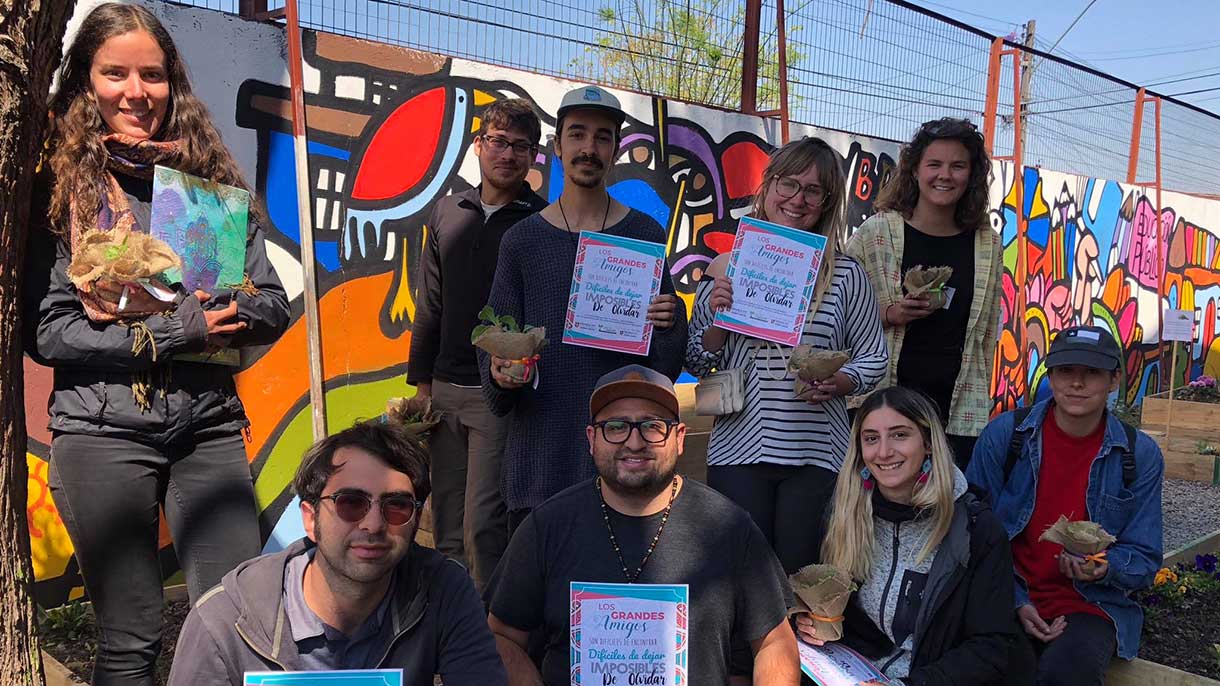
However today, Cerro Navia faces a situation of overcrowding and poverty. Its population lacks access to healthy and fresh food. In addition, the lack of green spaces within the area is conducive to the creation of heat islands. In 2016, several town communities such as, Comité des Allegados Los Conquistadores as well as the town hall of Cerro Navia wanted to promote urban agriculture to revitalize this neighborhood that was built in a space without vegetation. The first phase launched in 2018 as part of a QSF program which brought together around 20 low-income families around a collective garden and various training and mobilization activities. The first phase received a favourable reception by the community, which motivated a second phase carried out in collaboration with a municipal school and women leaders from the committee of Mujeres las Calas. Although still implemented as part of the QSF program, this project targets 35 of the poorest women in Cerro Navia. Single mothers or domestic workers, these women between the ages of twenty and seventy are at the heart of community life in this town. Because of their struggles that they have faced over the years, these women have successfully petitioned the government to construct subsidized housing, where they have lived since 2017. Furthermore, the creation of school vegetable gardens and family gardens will contribute to the reduction of heat islands and to the greening of the town. This will also raise awareness among primary age children of the importance of supporting the creation of healthy and sustainable urban environments and local agriculture and, more generally, will improve the well-being of the inhabitants of the district. Initially, a group of young people from Quebec worked with the women’s committees and the targeted municipal school in the development of the vegetable gardens and the organization of training and education activities on urban agriculture in hopes of encouraging more similar initiatives in the district. Thereafter, a participant from the municipality of Cerro Navia who has benefitted from the QSF program and who has had the opportunity to acquire knowledge, skills and concrete experience in urban agriculture will present useful skills and knowledge regarding the initiative in their neighborhood to groups in Montreal.
Year(s)
2019–2020Region(s)
Latin America and CaribbeanLieu(x)
ChiliShare
Objectives
The main objective of the project is to improve the living conditions, health and well-being of the inhabitants of the municipality of Cerro Navia, through an activity program on urban farming techniques and the greening of their neighborhood.
More specifically, the project aims to strengthen the food security of women and their families, to stimulate citizen participation around urban farming activities, to reduce heat islands, and to raise children’s awareness of the importance of participating in the creation of healthy and sustainable urban environments.
Partners
The association of families within the Comité de Allegados Los Conquistadores acts as the project coordinator in the field. It is a local organization representing families from the municipality of Cerro Navia. The association’s mission is to ensure the well-being of families, to represent them and to coordinate community activities with the City Council of Cerro Navia. The association organizes socio-cultural and festive activities, national and religious holidays, information and training workshops for families. The association regularly collaborates with Le Comité des Mujeres las Calas, a non-profit organization of women leaders which aims to improve the quality of life of women in the neighborhood through various activities focused on the right to housing and socio-cultural rights.
Our Québec partner is Y’a QuelQu’un l’autbord du mur (YQQ), which has expertise in the urban agriculture sector and the greening of concrete, underused or contaminated public spaces. Since 2003, the organization has implemented programs similar to that proposed for Cerro Navia in Chile. Alternatives and YQQ have been collaborating in the urban agriculture sector in Montreal since 2003, notably within the framework of the initiative “Paysage solidaire”, le Festival Cultiver Montréal and the greening program and community activities at Parc-Extension. YQQ will participate in the recruitment, pre-departure training of participants from Quebec and in the evaluation of the project.
Activities
The project revolves around two main components: a universal component and a reciprocity component.
Activities carried out under the universal component: creation of a school garden and greening projects in the municipality of Cerro Navia, conducting training workshops on urban agriculture for 35 women heads of families, training of trainers on urban agriculture, creation of educational tools to promote the learning of urban farming techniques in schools, diagnosis and consultation with the town hall of Cerro Navia to support the sustainability of the initiative, carrying out socio-cultural activities to promote local agriculture and greening efforts.
Activities carried out under the reciprocity component: participation in urban agriculture activities of the “Paysage solidaire” program carried out by the organization YQQ, participation in training activities offered by Alternatives and contribution to the activities of Cultiver Montréal, participation in the 12th edition of the Montréal Summer School on Urban Agriculture, facilitation of workshops and information seminars on the situation in Chile and the greening experience in the municipality of Cerro Navia.

Impacts of the project
Pas d'articles avec ces critères...